

| Getting your Trinity Audio player ready... |
You walk into your parents’ home and notice that the hallway feels narrower than it used to. The kitchen counters are full, the spare room is packed to the door, and you’re not sure where the medication is kept. You love them, and you want to help. But every time you raise the subject of decluttering, the conversation ends with hurt feelings, or in a fight.
If that sounds familiar, it doesn’t mean you’re handling it badly. It means two people who care about each other are looking at the same house in very different ways. As a professional organizer in Houston, I work with families on both sides of this, and the conversation is almost always harder than the decluttering itself.
Here’s how to talk to your parents about decluttering in a way that keeps you on the same side, including what to say, what to leave out, and where to begin.
Why This Conversation Is So Hard
To you, a crowded home may look like a safety risk, a future burden, or a sign that something is wrong. To your parents, the same home is full of memories, and it’s also the place where they feel independent. Asking them to clear it out can sound like you’re asking them to give up part of their life.
Neither view is wrong. But when you lead with yours, they hear criticism, and when they lead with theirs, you hear resistance. The way out is to begin with what they care about, and not with what you’ve noticed.
Know Your Real Reason First
Before you say anything, ask yourself what you’re really worried about. “It’s messy” is rarely the true reason. It’s usually one of these:
- A fall risk, such as a blocked walkway, a loose rug, or stairs with items on them.
- Things they need being hard to find, like medication, important papers, or a flashlight.
- A move that’s coming, now or in the future.
- A fire or evacuation risk, which especially matters in Houston, where a bad storm or hurricane can mean leaving with little notice.
When you can name the real reason, you can say it kindly and specifically: “I’d like to be sure you can get out quickly if you ever need to,” lands very differently from “this place is full of junk.”
Choose the Moment and the Opening
Where and when you bring it up matters. A holiday dinner with the whole family around is the wrong place, and so is the first ten minutes of a visit. Pick a calm moment when it’s just the two of you, and start with a question, not a statement.
This chart shows how small changes in wording change how a parent hears you.
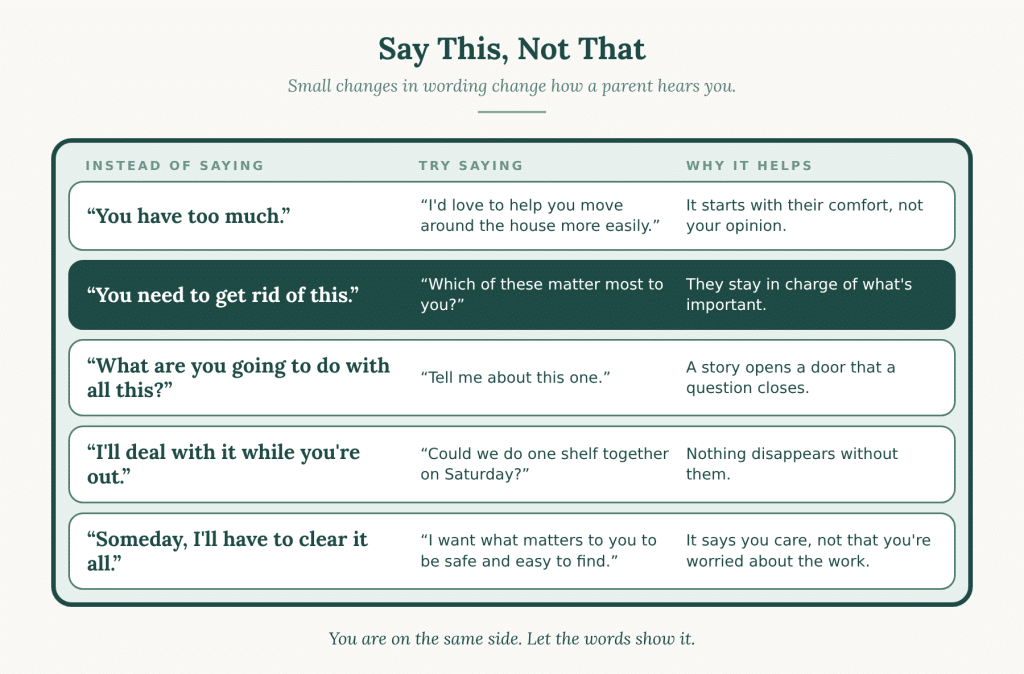
The idea behind every change is the same. You’re asking them what matters to them, instead of telling them what has to go.
Start Where It’s Easy
If your parents agree to begin, choose the easiest space first. The kitchen and bathroom are good places, because they hold practical items with fewer emotional ties. As one senior-care guide puts it, it’s easier to decide about spatulas than family heirlooms. Expired food, duplicate pans, and old medication are easy wins, and each one builds confidence for the harder rooms.
Keep the first session short and small, such as one cabinet, one shelf, or one drawer. Let your parent decide what stays, and offer your help with the lifting, the sorting, and the donation drop-off. You’re helping, not directing. Leave the photos, letters, and sentimental items for later, and never take over a decision that’s theirs to make.
If They Say No
Sometimes the answer will be no, and that’s okay. Don’t treat the first conversation as the only one. It often takes several, spread over weeks or months, before a parent feels ready. Step back, let the idea settle, and try again later, perhaps with a different starting point.
The exception is a real hazard. If there’s a blocked exit, a fall risk, or a health concern, it’s fair to be firmer, and to bring in their doctor, a family friend they trust, or a professional organizer. Many people will accept advice from an outsider far more easily than from their own child.
If You Live Far Away
Many adult children don’t live near their parents, and a pile of clutter is hard to help with from another city. A video walkthrough can help. With my Virtual Home Audit, a parent can show me their space on a live call, and you can join from wherever you are. I point out what’s costing them time, space, or safety, and tell them what to fix first. It gives the family a shared starting point, and a neutral voice.
Be Kind to Yourself, Too
Watching your parents age, and seeing their home change, can bring up grief and guilt. That’s normal. You don’t have to fix everything at once, and you don’t have to be the only one carrying it. Go at a pace that’s right for them, and for you.
If you’d like help starting this conversation, or your parents would be more comfortable with someone outside the family, as a decluttering expert and professional organizer I work with families across the Greater Houston area, in person and virtually from anywhere. You can start with a Virtual Home Audit, or book a session here, call 832-271-7608 to get started even faster, or, if you still have questions, complete the form below. I’ll answer them as quickly and completely as possible.

Working with Taya and her team is easy. You can book an appointment easily on her website, or contact her directly at 832-271-7608
- How to Talk to Your Parents About Decluttering - November 3, 2026
- Why You Can’t Start Decluttering, and How to Begin - November 2, 2026
- How to Set Up Your Guest Bathroom Before Holiday Guests Arrive - October 30, 2026