
| Getting your Trinity Audio player ready... |
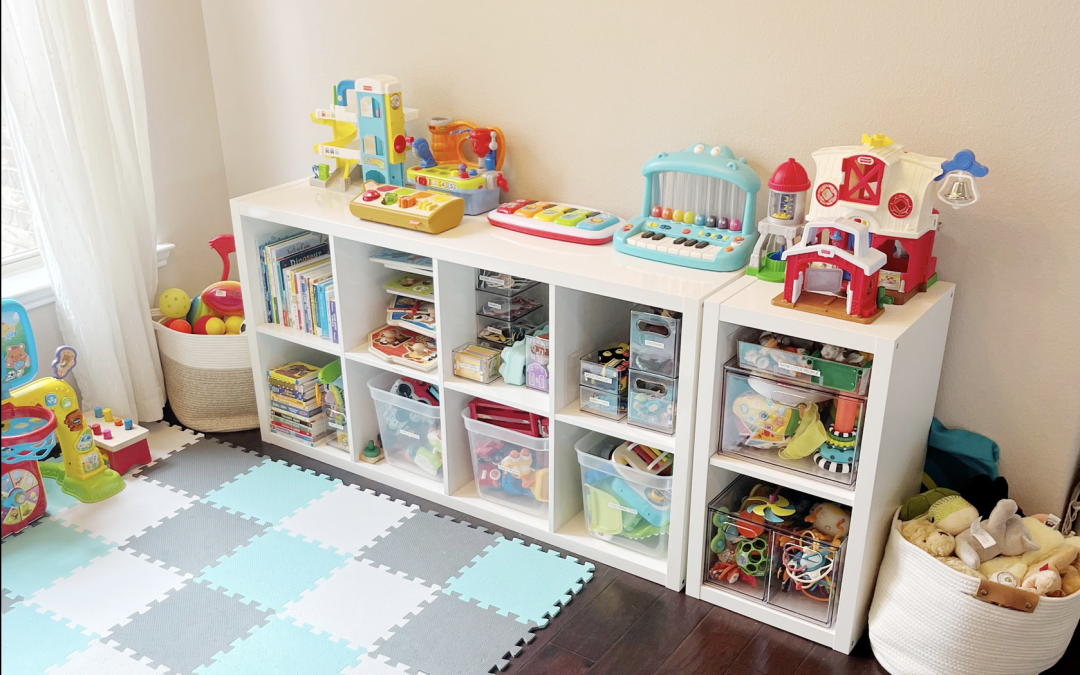
Somewhere in your house, there’s a toy bin that no longer closes. Inside it: a dinosaur missing a leg, forty loose blocks, a puzzle with three pieces gone, and one very loud thing nobody remembers being given.
Now the sales are on. Relatives are shipping gifts early, a box has been sitting by the door since Monday, and two more are on the way. Every one of those toys needs somewhere to go, and right now the answer is “on top of the pile.” That’s how a playroom floor becomes impossible to cross by the end of December.
Making room doesn’t mean getting rid of everything. It means deciding, before the gifts arrive, what stays out, what rests in a closet, and what leaves the house. And unless they’re babies, the kids make those decisions with you. It’s their room and their toys, and a sort they helped with is one they’ll actually keep up. It’s worth doing now for two reasons.
The first is space. New toys with nowhere to live end up on top of the old ones, and the old ones end up under the couch.
The second is play. In a University of Toledo study of 36 toddlers, aged 18 to 30 months, many children in a room with 16 toys handled ten or more of them in the first 15 minutes, hopping from one to the next. With four toys, they stayed with each one about twice as long, and played with it in more varied ways. It’s a small study, but anyone who has watched a child walk away from a mountain of toys to play with the box can see the point.
You can finish this in a weekend, one area at a time. Here’s how.
Step One: Pick One Area, Block Out the Time, and Bring the Kids In
Start with one place, such as the toy box, a shelf, or the corner of the playroom, and give it 30 to 45 minutes. Trying to do the whole house at once is how toy sorts stall halfway. Unless your children are babies, sort with them, not around them. Tell them what you’re doing and why: there’s going to be new stuff coming, so we’re making room. Even young children usually know which toys they’ve outgrown and which ones they’d never part with. Sorting while they’re at school and handing them an empty shelf is how you get tears, and toys fished back out of the bag. Keep the talk to what you’re sorting, and leave any gifts out of it.
Step Two: Pull Everything Out and Group Like with Like
Tip the bin out onto a sheet or the floor, and group the toys by type: blocks and building sets, vehicles, dolls and figures, stuffed animals, games and puzzles, art supplies, and anything that takes batteries. Seeing 14 of the same thing in one pile is often all it takes to decide that you don’t need all 14.
Step Three: Sort Into Four Piles
Every toy goes into one of four piles, and none go back in the box unsorted. Let your child pick up each toy and choose its pile. You can step in for the broken pieces and the duplicates, but the keep-or-pass call is theirs. Younger children do best with a simple question: “Do you still play with this?”
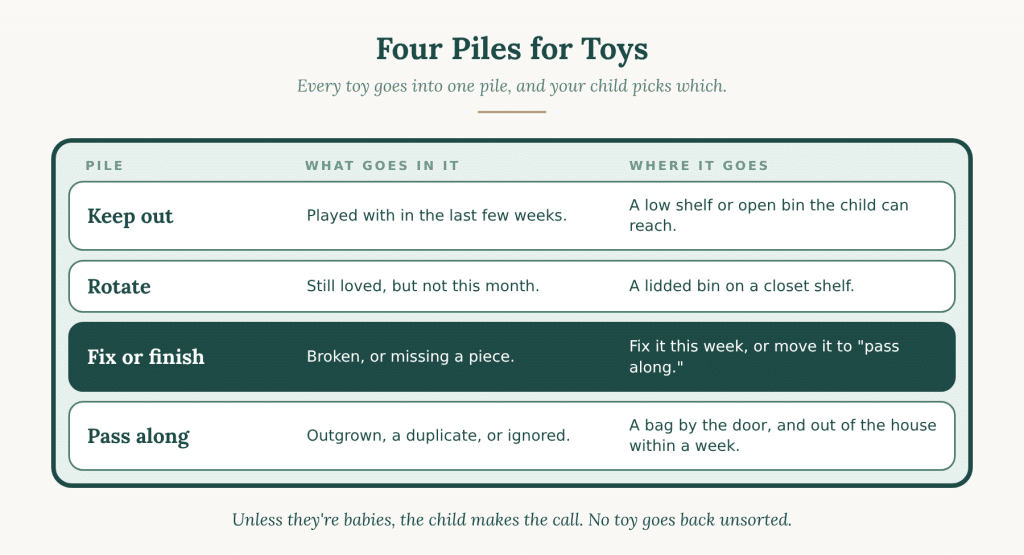
The “fix or finish” pile needs a deadline. If it isn’t fixed by the weekend, it moves to “pass along.” A puzzle or game with missing pieces that can’t be replaced belongs there too. For the pass-along pile, decide where it goes before you start, whether that’s a friend, a school, or a donation center, and get it out of the house within a week. Children often find it easier to let go of a toy when they know who gets it, so let them help choose, and come along for the drop-off if they’d like to. A bag that sits by the door for a month goes back into the room.
Step Four: Handle the Hard Ones
Some toys are easy. Others come with a story: the stuffed animal from a grandparent, or the first of something. For those, use a keepsake box with a firm size limit, one box and no more. Let your child choose what goes in. Anything that fits goes in, and the rest has to earn a place on a shelf. If they won’t let go of something, that’s their answer, and it stays.
For the toys you can’t decide on, two questions help. Has it been played with since the summer? Would they miss it if it were gone for a month?
Step Five: Make Room Before the Gifts Arrive
Count the space you have, and set a limit for each part of it. Then make a rule: if something new comes in, something goes out. Explain the rule to your children ahead of time, and let them choose which toy makes room, so it’s their trade and not your edit.
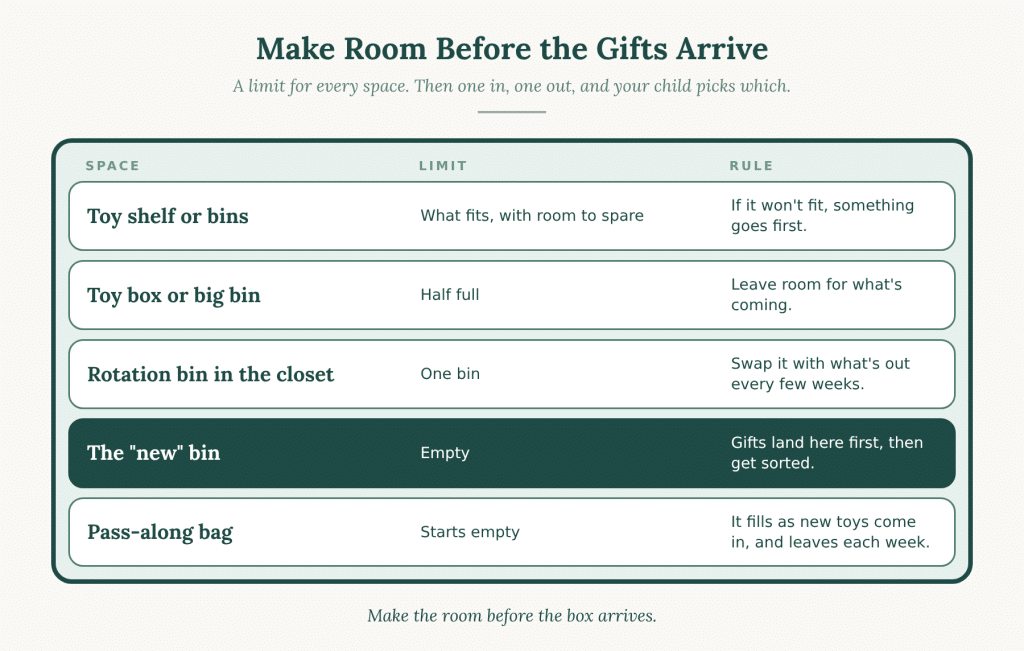
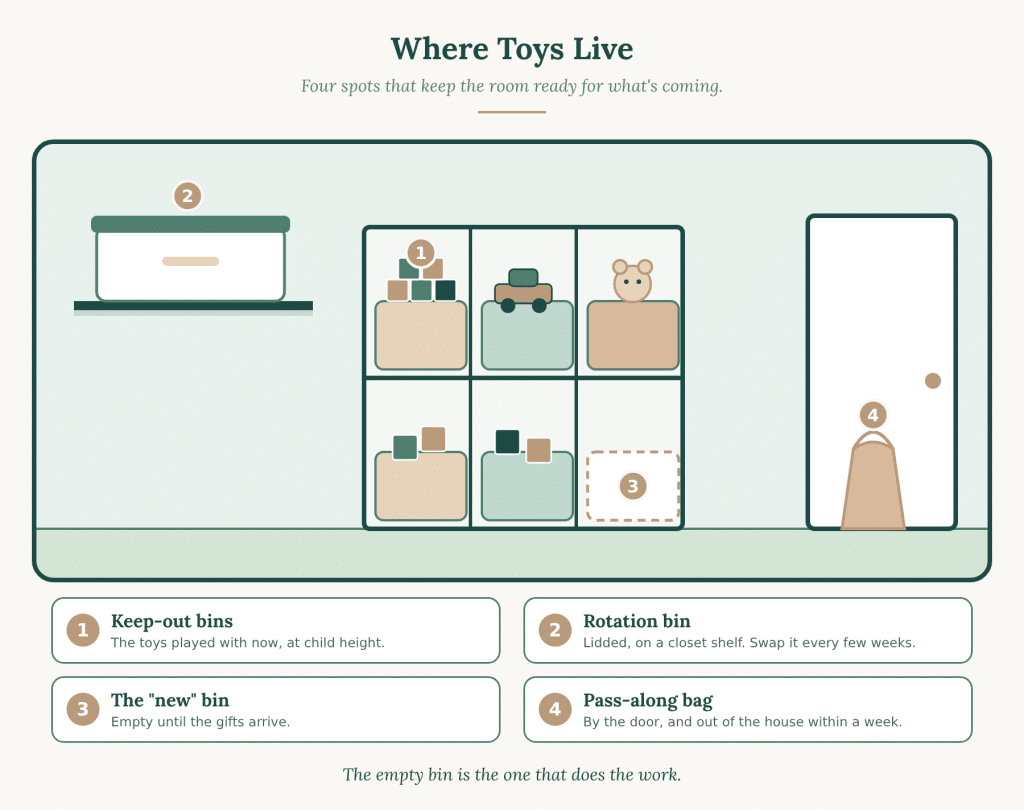
The most useful item on the list is the “new” bin. Leave it empty. When gifts arrive, they land there first, and you sort them later. It keeps the new toys from spreading across the room.
Step Six: Set Up a Rotation
Keep a lidded bin of toys in a closet, and swap it with what’s out every few weeks. Let your child help fill it, and tell them the toys are resting, not gone. Toys that have been out of sight for a while feel new again. A rotation also solves the holiday haul: put out some of the new toys now, and hold the rest back for January.
Step Seven: Plan for the Boxes Themselves
Early gifts will keep arriving through the sales, so give them a place before they do. Keep unwrapped toys in your hiding place until the day. Open each box when it arrives, check that everything works and nothing is missing, and flatten the packaging. I wrote about that whole process in how to organize holiday gifts during Black Friday sales.
The Shopping List
Look at what you have first, then buy only what fills a gap. Here’s what I’d look for:
- Open bins at child height, for the toys that are out
- Lidded bins for the rotation and the keepsake box
- Labels with pictures, for children who can’t read yet
- A low shelf or a cube unit
- Zip bags, for game and puzzle pieces
- A large bag or box for the pass-along pile
If you’re choosing bins, I wrote about why deep storage baskets often don’t work.
After the Holidays
Once the gifts settle, do one more pass in January. Anything new that hasn’t been touched can move into the rotation bin, and anything that has been replaced by a favorite can go to the pass-along pile.
If the toys have taken over more than one room, that’s a bigger job than a bin. It usually means the whole space needs to be sorted and set up again, and that’s where I can help.
As a decluttering expert and professional organizer, I work with clients in person across the Greater Houston area and virtually from anywhere. I can sort and set up spaces like kids’ rooms and playrooms with you, and my calendar fills quickly in the weeks before the holidays, so now is the time to ask.
Book a session now, or call 832-271-7608 and we’ll find a time before the gifts arrive. If you have questions first, fill out the form below and tell me what you’re working with.

Working with Taya and her team is easy. You can book an appointment easily on her website, or contact her directly at 832-271-7608
- How to Organize Toys and Make Room Before the Holidays - November 18, 2026
- How to Organize Holiday Gifts During Black Friday Sales - November 16, 2026
- How to Fake a Pantry in Any Kitchen Before the Holidays - November 13, 2026