
| Getting your Trinity Audio player ready... |
Hey friend,
You’ve might have seen the videos on social media. Someone stands in a parent’s packed home and says, “Look what my mom left me.” The tone is angry, and the comments are full of people saying they’ll never leave a mess like that for their own children.
If you’re a parent or grandparent watching that, it can make you feel guilty about every box in your attic. It can also make decluttering feel like a punishment, or like something you’re doing for everyone else because you’re a burden.
I’d like to offer a gentler way to look at it. As a professional organizer in Houston, I’ve helped many people go through a lifetime of belongings, and the ones who feel best afterward do it for themselves. They want a home that’s easier to live in now, and they want the people they love to have something better than a pile of decisions to make.
Here’s how to declutter so your kids don’t have to, in a way that feels like a gift and not a chore.
Your Children Are Not Rejecting You
One of the hardest parts is finding out that your children don’t want the things you’ve saved. It can feel personal, but it usually isn’t. One writer in an AARP essay put it plainly: when her adult children turned down dishes, furniture, and keepsakes, a “no thanks” was not a rejection of her.
Nostalgia is personal. Something that carries strong memories for you may not mean much to your children, and styles and ways of living change. Many younger people have smaller homes, fewer places to store things, and little interest in formal china or large furniture. That has more to do with space and taste than with how they feel about you.
Children tend to want items that fit in their homes, that they’ll use, that suit their taste, or that bring back a good memory. The best way to find out which is to ask them.
Ask Them Now, While You Can Hear the Answer
Don’t guess what your family wants. Ask, and ask early. Take photos of the items you’re unsure about, or invite your children over to look, and let them say yes or no. People are often surprised. A child may pass on the china and ask for a photo album, a set of tools, or an old school desk.
Asking now has another benefit. It can head off disagreements between brothers and sisters later, because everyone has already said what they want, and you’ve been able to hear it.
Start with the Easy Rooms
You don’t need to begin with the photographs or the letters. Start where the decisions are simple: the kitchen, the bathroom, the linen closet, and the garage. Expired food, duplicates, and things you haven’t used in years can go first. Every small win makes the next one easier, and you’ll have a clearer view of what’s left.
Go at a gentle pace. One drawer or one shelf at a time is enough, and there’s no deadline.
Ask Four Questions About What Matters
For the things that carry meaning, a few simple questions can help you decide. This chart walks you through them.
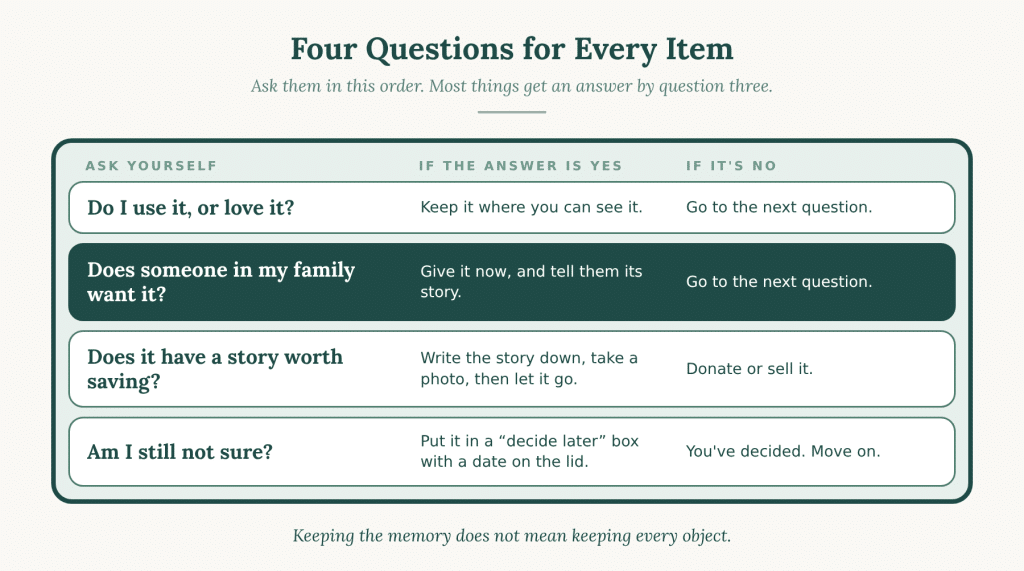
The important idea is the third question. Keeping the memory doesn’t mean keeping every object. A photo of your mother’s teapot, with a note about when she used it, can be worth more to your family than the teapot sitting in a box.
Pass On the Story, Not Only the Object
An item with its story attached is a very different gift from an item without one. Write a short note about a few special pieces, or record yourself telling the story on your phone. Who gave it to you, and why did you keep it? What did it mean? Some people write a short memoir for their children, and many families treasure that far more than the things themselves.
If someone in your family does want an item, give it now, with its story. Seeing it used and enjoyed is a joy for you, too.
Make the Important Things Easy to Find
One kind of clutter matters more than any other, and that’s paperwork. Put your important documents in one place, and tell a trusted person where it is. In Houston, it also helps to keep key papers in a waterproof folder you can grab quickly if you need to evacuate for a hurricane. For questions about wills and estates, an attorney is the right person to ask, and I’m not a substitute for that advice.
A Gift, Not a Guilt Trip
You don’t need to do this out of guilt. A home with less clutter is easier to move around in, easier to clean, and calmer to live in. Giving your family a few clear choices, and the stories behind them, is one of the kindest things you can do, and you can do it at your own pace.
If you’d like some help, as a decluttering expert and professional organizer I work with clients across the Greater Houston area, including downsizing and general decluttering. You can start with a Virtual Home Audit, where we look at one space together on video, or book a session here, call 832-271-7608 to get started even faster, or, if you still have questions, complete the form below. I’ll answer them as quickly and completely as possible.
If you’re an adult child worried about a parent’s home, I wrote a post for you too: How to Talk to Your Parents About Decluttering

Working with Taya and her team is easy. You can book an appointment easily on her website, or contact her directly at 832-271-7608
- Decluttering So Your Kids Don’t Have To: A Gentler Way - November 6, 2026
- How to Talk to Your Parents About Decluttering - November 3, 2026
- Why You Can’t Start Decluttering, and How to Begin - November 2, 2026