
| Getting your Trinity Audio player ready... |
Hey friend,
Picture the last twenty minutes before a Thanksgiving – or an holiday – dinner. The turkey is resting on the counter, the oven is full, and three dishes are ready to go. Then you notice that the mashed potatoes have no bowl, the gravy has no ladle, and the only platter big enough for the turkey is in a box in the garage.
None of this is about how many dishes you own. It’s about not having matched the menu to the serving pieces ahead of time. Most hosts plan what to cook, and almost nobody plans how every dish will get from the stove to the table, which is where the day goes wrong.
You have a few weeks before the big holiday meal season, which is plenty of time to plan it properly. Here’s how to work through it, including how to plan the oven, how to keep food at a safe temperature, and how to count your table.
Step One: Plan Every Dish, Start to Finish
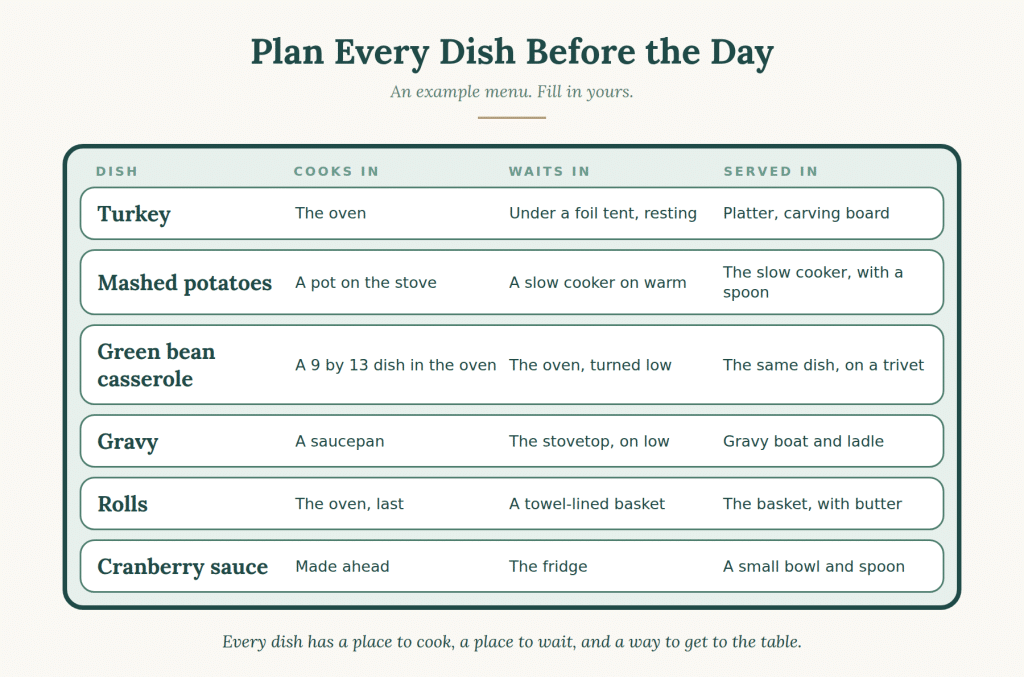
Write out your full menu, and next to each dish, answer three questions: what does it cook in, where does it wait, and what is it served in?
Here’s an example:
- Turkey: cooks in the oven, rests under a foil tent, and is served on a platter with a carving board.
- Mashed potatoes: cook in a pot on the stove, wait in a slow cooker on warm, and are served from the slow cooker with a spoon.
- Green bean casserole: bakes in a 9 by 13 dish, waits in the oven on low, and is served from the same dish on a trivet.
- Gravy: is made in a saucepan, waits on the stovetop on low, and is served from a gravy boat with a ladle.
This is where the problems show up. You’ll find a dish with nowhere to wait, a bowl you’re one short of, or a serving spoon that doesn’t exist. Many dishes can go to the table in the dish they were baked in, which saves you washing and finding another bowl. Just make sure you have a trivet for each one.
Step Two: Plan the Oven, Because It’s the Bottleneck
On the day, your oven is the problem. A turkey takes up the whole thing for hours, and half of your sides need it too.
The turkey needs to rest after it comes out, usually 20 to 30 minutes, and longer for a very large bird. That rest is your window. While it sits under a loose foil tent, the oven is free for rolls, casseroles, and anything that needs to be reheated. Write the order down, and work backward from the time you want to sit down.
Dishes that don’t need the oven help a lot. Mashed potatoes can wait in a slow cooker, gravy can stay warm on a low burner, and cranberry sauce can be made days ahead and kept in the fridge. The fewer dishes that need the oven at the last minute, the calmer the kitchen will be.
Step Three: Keep Hot Food Hot and Cold Food Cold
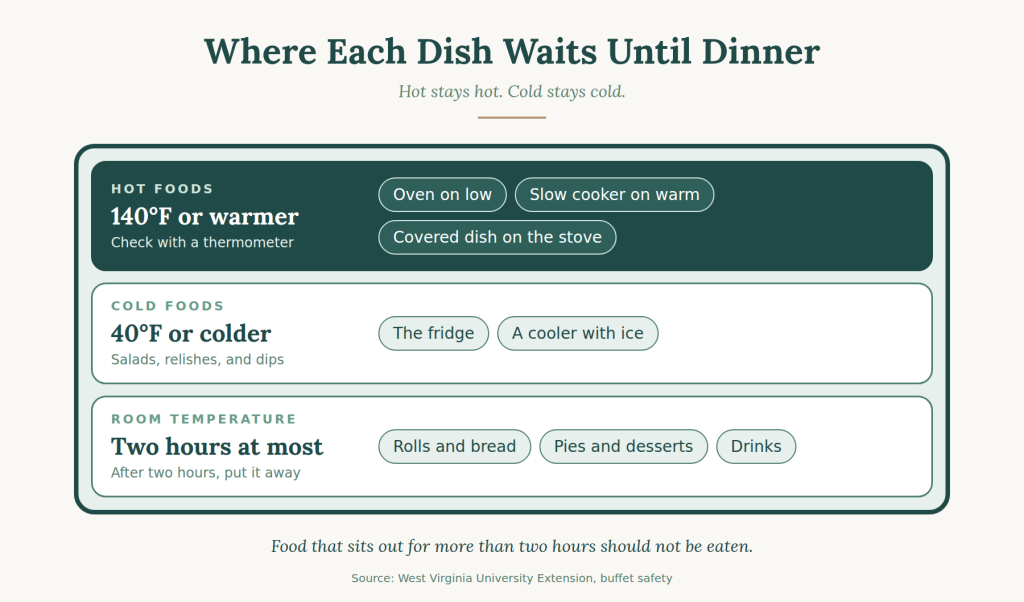
Once the meal is ready, it will probably sit for a while, so plan where each dish waits. Food safety guidance says hot food should stay at 140°F or warmer, and cold food at 40°F or colder. Food that has been at room temperature for more than two hours should be put away or thrown out.
- Hot dishes: keep them in the oven on low, in a slow cooker on warm, or covered on the stove. A food thermometer will tell you if they’re holding.
- Cold dishes: keep them in the fridge until the last minute, or in a cooler with ice.
- Rolls, pies, and drinks: these can sit at room temperature, but not for more than two hours.
If you need fridge space for cold dishes, my fridge and freezer guide shows how to clear it ahead of time.
Step Four: Count Your Table
Most tables seat fewer people than the host hopes. A good rule is about 24 inches of table width per person. Measure the length of each side of your table, divide by 24, and you’ll know how many seats fit comfortably. A table that’s 6 feet long on each side, for example, gives you three seats per side.
If the number is too low, decide now how you’ll add seats: a folding table at the end, a bench, or a separate table for kids. Then count what you’ll need for every guest: a dinner plate, a fork, a knife, a napkin, and two glasses, one for water and one for something else. Add a dessert plate and fork for each person, and a few extra place settings for spills and last-minute guests.
If you’re short, now is the time to borrow. When you do, put a strip of painter’s tape on the bottom of each borrowed dish with the owner’s name. It’ll make it easy to return everything after dinner, and nobody will lose a casserole dish.
Step Five: Check Your Linens Early
Take out the tablecloth, napkins, and any placemats, and look at them in good light. Stains and creases don’t show up until you unfold them. In Houston, linens kept in a garage or attic can pick up moisture and a musty smell, so look closely. I covered why in what not to store in a Houston garage or attic.
Wash and iron them a week or so ahead. If a stain is still there after washing, you’ll have time to find a different tablecloth.
Step Six: Label and Stage the Day Before
This is the step that makes the day itself calmer. The day before, set the table completely, with plates, flatware, glasses, and napkins. Then take every serving dish, bowl, and platter and put it on the counter or sideboard, with a sticky note on each one saying what food goes in it and which spoon goes with it.
When the food is ready, nobody has to ask where it goes. If you have guests who offer to help, they can look at the notes and do it themselves.
Step Seven: Give Serving Pieces One Home
When the meal is over, put the serving pieces back together in one place, such as one shelf, a bottom cabinet, or a labeled bin. Stand platters on their edge in a vertical divider so you can slide one out without moving the stack. Keep each serving spoon with the bowl it goes with.
The Shopping List
Count what you have first, then buy only what fills a gap. Here’s what I’d look for:
- A large serving platter and a carving board
- Trivets for hot dishes
- Serving spoons and a ladle
- A gravy boat:
- An instant-read food thermometer
- An insulated carrier or cooler for transporting hot or cold dishes
- A vertical divider for platters and trays
- Painter’s tape and a marker
After the Meal
Once the dishes are washed and put away, write down what you were short on, and what you never used. Next year’s list will be half done, and you won’t have to repeat the search.
Planning a holiday table is mostly a set of decisions: what’s cooking where, what’s served in what, and where everything lives afterward. If your kitchen turns into a scramble every time you host, that’s the kind of larger home organization project I help clients with. I work through it beside you, then build a setup around the way you cook and entertain.
As a decluttering expert and professional organizer I work with clients in person across the Greater Houston area and virtually from anywhere. Book a session here, call 832-271-7608 to get started even faster, or, if you still have questions, complete the form below. I’ll answer them as quickly and completely as possible.

Working with Taya and her team is easy. You can book an appointment easily on her website, or contact her directly at 832-271-7608
- How to Organize Your Serving Dishes and Table Before Thanksgiving - October 28, 2026
- How to Set Up Your Entryway Before Holiday Guests Arrive - October 26, 2026
- How to Organize Your Fridge and Freezer Before Thanksgiving - October 23, 2026