
| Getting your Trinity Audio player ready... |
If you’ve ever taken one look at a messy room and immediately felt too discouraged to even start, I want you to know that’s not laziness. It’s a real pattern, and it’s one of the most common reasons a space stays stuck- and cluttered- instead of getting better.
Here’s how it usually goes: the mess builds up, and instead of just seeing a task, you start feeling like the mess says something bad about you.
That feeling is uncomfortable enough that you begin to avoid the room entirely. Avoiding it means nothing changes. Nothing changing means more piles up.
And now there’s more mess, which brings on more shame, which makes you avoid it even harder. That’s the shame-avoidance loop, and it’s the actual problem — not the dishes, not the laundry, the loop itself.
The good news is a loop like this has real, specific places to break it. Here’s how.
First, Tell the Task From the Shame Story
Before you can fix this, you need to catch it happening, and there’s a quick way to check. Ask yourself: am I thinking about a task, or a story about myself?
“The dishes aren’t done” is a task. It’s neutral. It just needs doing.
“I can’t believe I let it get this bad, what’s wrong with me” is a story. It’s not about the dishes anymore — it’s about your character, and stories like that are exactly what shut down motivation instead of building it.
The next time you’re standing in a messy room feeling that heavy, stuck feeling, run this check. If it’s a task, you can just start it. If it’s turned into a story, that story is the actual thing blocking you, not the mess itself.
Start With the Lowest-Stakes Area, Not the Worst One
Most decluttering advice says tackle the space that bothers you most. When shame is part of the picture, that’s exactly backwards. The area that upsets you most is also the one carrying the most emotional weight, which means it’s the hardest possible place to start from a dead stop.
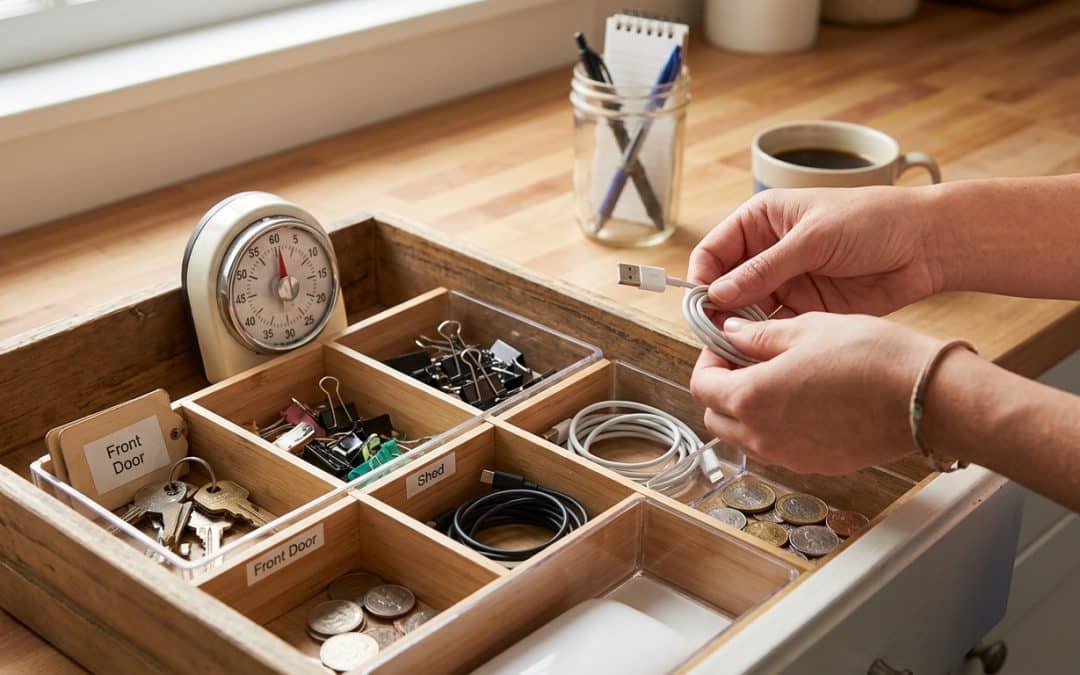
Instead, pick the area with the least emotional charge — a junk drawer, a bathroom shelf, one countertop — even if it’s not the thing actually stressing you out. The goal isn’t fixing the biggest problem first. It’s proving to yourself that you can start and finish something, which is exactly the evidence the shame story is telling you that you don’t have.
Once you’ve got one small win, the harder area gets easier, because you’re not starting from zero anymore.
Set a Timer for 10 to 15 Minutes, No Exceptions
Marathon decluttering sessions are where shame does its worst damage. The longer you’re in a space confronting everything at once, the more time there is for “I should throw this out” to turn into “I can’t believe I have this many things I don’t need,” which turns into a much bigger, much more painful spiral than the task itself required.
A short, fixed time limit prevents that slide. Ten to fifteen minutes is enough to make real progress and short enough that it’s hard for the session to turn into self-judgment. When the timer goes off, you stop — even if you want to keep going, even if the area isn’t finished. Stopping on time, repeatedly, is what proves this is a manageable task and not an endless referendum on your character.
Swap the Specific Sentence You’re Saying to Yourself
“Be kinder to yourself” is true, but it’s too vague to actually use in the moment. Here’s something more specific: the next time you catch the shame story running — “I can’t believe I let this happen” — swap it for one exact sentence instead: “This built up over time, and it’s going to get resolved the same way.”
That sentence does two things at once. It removes the character judgment, and it sets a realistic expectation — not “I have to fix this today,” which just recreates the marathon-session problem, but a scope that actually matches how the mess got there in the first place.
Say it out loud if that helps. The goal isn’t positivity for its own sake. It’s replacing a sentence that stops you with one that doesn’t.
Know When to Bring in Outside Support, and What Kind Actually Helps
Sometimes the shame-avoidance loop is strong enough that none of the above gets you moving on your own, and that’s not a failure — it’s useful information about what this particular space needs.
A body-doubling session — working alongside someone else, in person or on a call, even if they’re not helping with the task itself — can be enough to interrupt the avoidance, because the accountability of someone else’s presence often does more than willpower alone. A friend willing to sit with you for twenty minutes while you sort one drawer works. So does a professional organizer, for the areas where the emotional weight is heavier than a friend’s presence can offset.
The point isn’t that you’re incapable of doing this alone. It’s that some tasks are genuinely easier with another person there, and there’s no reason to keep white-knuckling through a room that’s been stuck for months when outside support would move it in an afternoon.
The Loop Breaks One Small Proof at a Time
None of this works by deciding, once, to stop feeling shame about a messy space. It works by interrupting the loop in a few small, specific places — catching the story instead of the task, starting low-stakes instead of high-stakes, timing the session instead of marathoning it, swapping the sentence, and asking for help when it’s genuinely needed. Each one is small. Together, they’re what actually turns “I can’t keep up” into a room that’s just a room again.
As a decluttering expert and professional organizer I work with clients in person across the Greater Houston area and virtually from anywhere, and this exact loop — shame, avoidance, more mess — is one of the most common patterns I help people work through, not just the physical organizing itself.
Book a session here, call 832-271-7608 to get started even faster, or, if you still have questions, complete the form below. I’ll answer them as quickly and completely as possible.

Working with Taya and her team is easy. You can book an appointment easily on her website, or contact her directly at 832-271-7608