
| Getting your Trinity Audio player ready... |
Hey friend,
A well-set-up nightstand does one thing. Everything you need between lights-out and your alarm is within reach, and nothing else is there. Most nightstands don’t work that way, because things get added and almost nothing ever gets taken off.
If yours has gotten away from you, that’s completely normal. The nightstand might be the easiest spot in the house to lose control of. It’s the last stop of the day, when you’re tired and not thinking about where anything goes, so you set one thing down, then another, and by the weekend there’s a small pile. Nobody plans it, and it isn’t a flaw in you. It’s a small surface with a very big job.
The good news is that it’s also one of the quickest places to fix. Here’s the organized setup I’d put together for any nightstand, piece by piece, including what to buy and what to measure first.
Step One: Empty It and Clear Out What Doesn’t Belong
Take everything off the top and out of the drawer, and set it all on the bed. Throw out the obvious: used tissues, wrappers, receipts, dried-out pens, dead batteries, snapped hair ties, and cords for devices you no longer own. Check dates on lotion and lip balm. Mugs and glasses go back to the kitchen, and anything from another room goes home.
Don’t buy anything yet. You’ll know what to buy, and what size, once you can see what’s left.
Step Two: Set Up the Top With Four Things
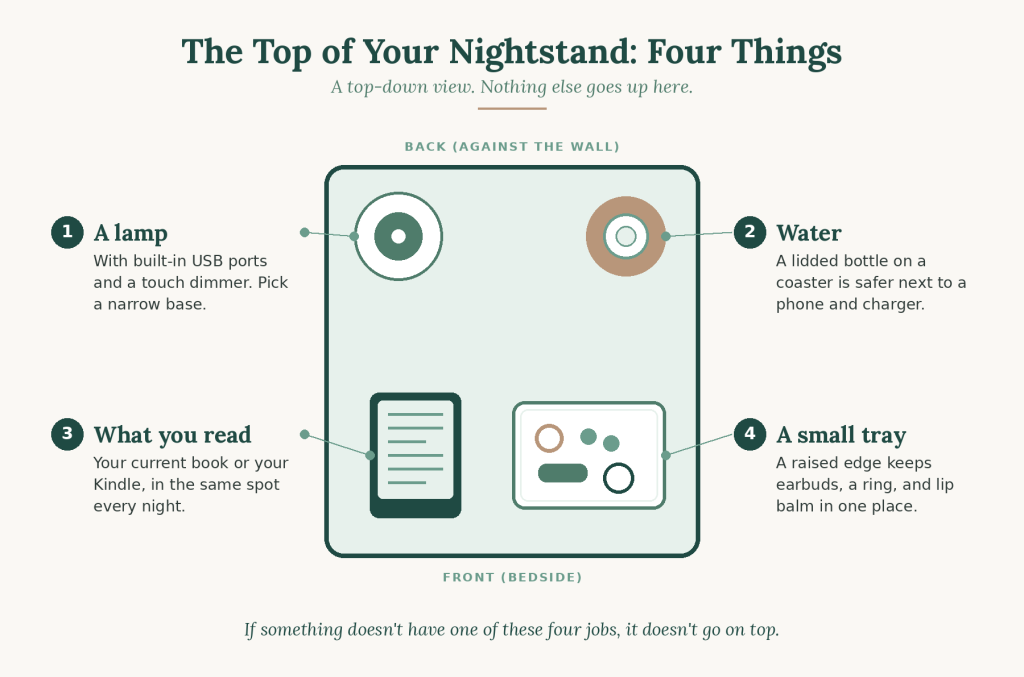
The surface is for four things and nothing else.
- A lamp. Look for one with built-in USB ports and a touch dimmer. It does the work of a lamp and a charger, so you need one fewer plug on the surface. Pick a narrow base so it doesn’t use up half the top.
- Water. A bottle or glass with a lid is safer than an open glass sitting next to a phone and a charger. Put it on a coaster so it doesn’t leave rings on the wood.
- What you read. Your current book, or your Kindle. Put it in the same place every night so you can find it half-asleep.
- A small tray. Choose one with a raised edge, roughly the size of a saucer. Earbuds, a ring, lip balm, and a hair tie all land here instead of scattering across the top. A tray turns a handful of loose items into one small group.
If something doesn’t fit in one of those four jobs, it doesn’t go on top.
Step Three: Set Up the Drawer in Zones
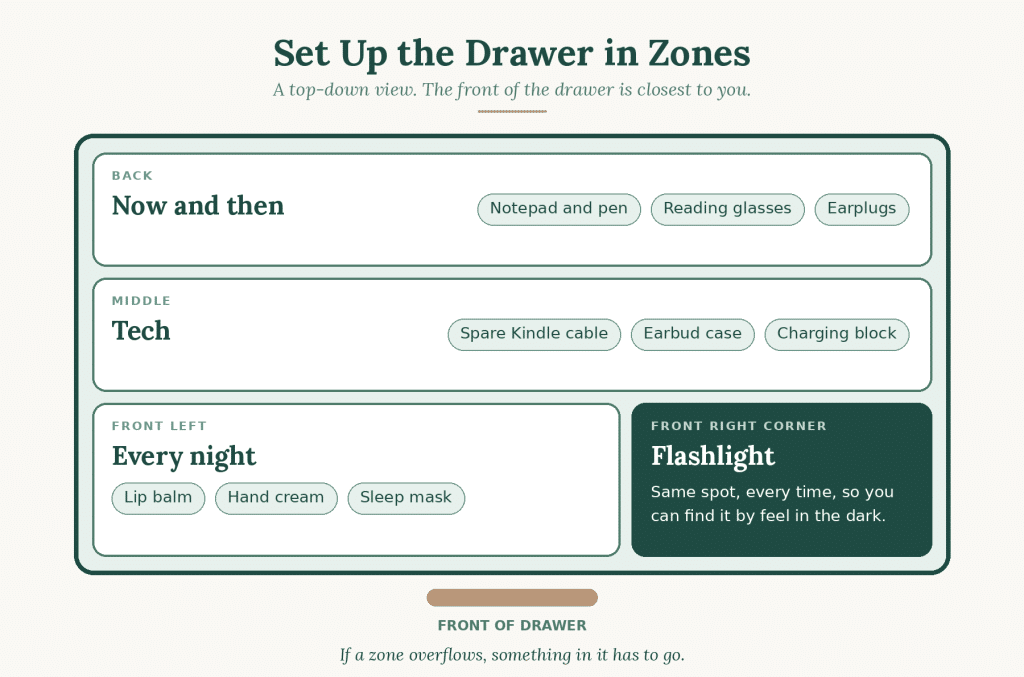
Measure the inside of the drawer before you buy any organizer: width, depth, and height. Drawers vary a lot, and a divider that’s even an inch off will slide around. An adjustable, expandable drawer organizer, or a set of small trays, works for most.
Then divide the drawer by how often you reach for things.
- Front left: what you use every night, like lip balm, hand cream, and a sleep mask.
- Front right corner: a flashlight, always in the same spot, so you can find it by feel in the dark.
- Middle: tech. A spare charging cable for your Kindle, your earbud case, and a charging block.
- Back: things you use now and then, like a notepad and pen, reading glasses, and earplugs.
If one zone overflows, something in it has to go. That’s what keeps the drawer from turning back into a junk drawer.
Step Four: Sort Out the Power
Cords are what turn a tidy nightstand into a messy one, so give them a plan.
If your nightstand sits tight against the wall, a plug with a flat or right-angle head lets it sit flush instead of being pushed out by a bulky plug. If you charge a phone, earbuds, and a watch, a 3-in-1 wireless charging stand puts all three in one footprint instead of three cables.
Choose a cable between six and ten feet. A cable that’s too short pulls the phone off the surface, and one that’s too long ends up in a knot behind the bed. Run it up the back edge of the nightstand and secure it with adhesive cable clips so it stays put.
A Kindle or other e-reader holds its charge for weeks, so it doesn’t need a permanent spot on the charger. Keep its cable in the drawer and plug it in when the battery runs low, and save the nightly charging spot for your phone.
Step Five: Add a Flashlight You Can Find
If the power goes out, you want light within reach without digging through a drawer. A rechargeable LED flashlight is a good choice, since you don’t need to hunt for batteries. Some plug-in nightlights also come on automatically when the power goes out, which can be a helpful backup near the bed.
Keep the flashlight in the same drawer corner every time. Check or recharge it twice a year, and the weekend the clocks change is an easy reminder.
If Your Nightstand Has No Drawer
You can still use the same zones. Put a small lidded box or basket on the lower shelf, and divide it the way you would a drawer. A bedside caddy that tucks between the mattress and the frame also works, as long as it holds only what you use at bedtime.
The Shopping List
Measure first, then buy. Here’s what I’d look for:
- A lamp with USB ports and a touch dimmer
- A lidded water bottle and a coaster
- A small tray with a raised edge:
- An adjustable drawer organizer
- A flat or right-angle extension cord
- A 3-in-1 wireless charging stand
- Adhesive cable clips
- A rechargeable LED flashlight
Keep It Going With a Two-Minute Reset
A nightstand will drift no matter how well it’s set up, because you use it every day. Reset before you rest: take the dirty glass to the kitchen, throw out the used tissues, and put the book or Kindle and the phone back where they go. Two minutes at night keeps it ready for the morning.
If your nightstand, or your whole bedroom, has become the spot in your Houston home you avoid looking at, that’s exactly the kind of project I help clients with. As a decluttering expert and professional organizer I work with clients in person across the Greater Houston area and virtually from anywhere. Book a session here, call 832-271-7608 to get started even faster, or, if you still have questions, complete the form below. I’ll answer them as quickly and completely as possible.

Working with Taya and her team is easy. You can book an appointment easily on her website, or contact her directly at 832-271-7608