
| Getting your Trinity Audio player ready... |
If you have a student heading to college this fall, there is a good chance you have already spent time on Pinterest, TikTok, or Instagram looking at dorm room transformations.
And I want to gently say: step away from the content.
Not because a well-organized dorm room is not a worthy goal. It absolutely is. But because the version of dorm room organization you see online — the matching storage sets, the coordinated color schemes, the fully styled rooms that look like a boutique hotel for an eighteen -year-old — bears almost no relationship to what actually works in a shared college dorm room. And chasing it is one of the most reliable ways to spend significant money on things that will not fit, will not be used, or will create friction rather than solve it.
I have helped enough families through move-in to know what actually makes a difference. Here is what I want you to know before you set foot in Target.
The Dorm Room You Are Imagining Is Not the Room Your Student Is Moving Into
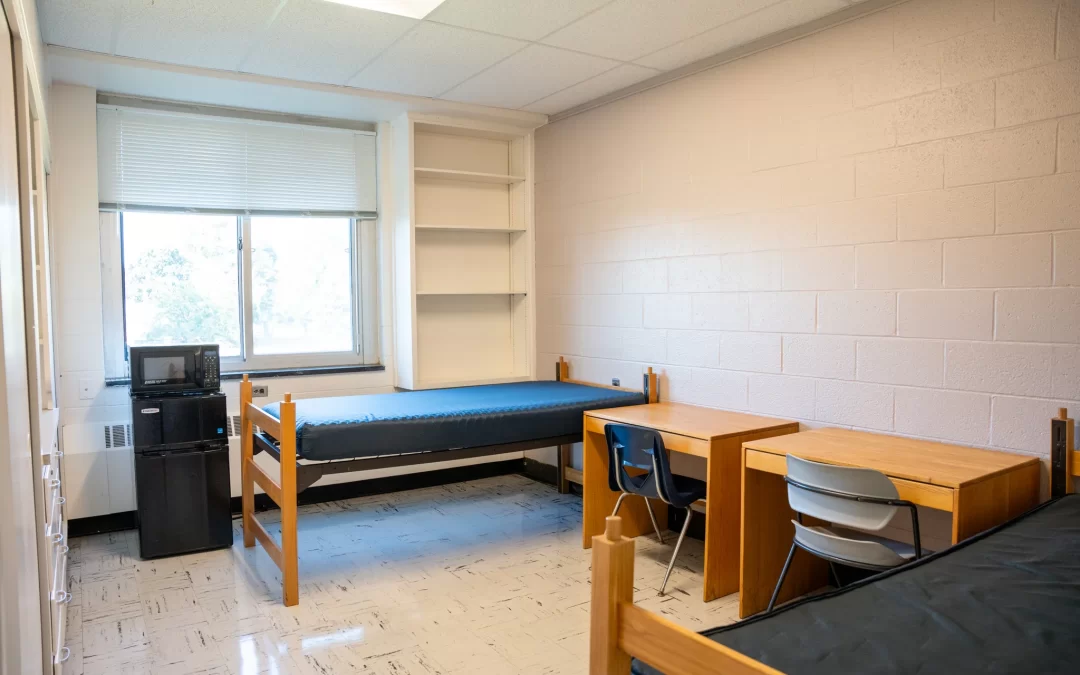
The dorm rooms you see online are almost always single occupancy, already furnished in a specific way, and styled for a photograph. Your student’s actual room will almost certainly have a roommate — meaning half of every decision about the space is not yours or your student’s to make unilaterally.
Before you buy a single storage solution, your student needs to have a real conversation with their roommate. Not a polite Instagram follow and a few DMs — an actual conversation about how they each live.
Who is bringing the mini fridge? The microwave? Who is bringing a TV? One of each is enough. Two of each in a room the size of a large walk-in closet is a problem. And two mini fridges, two sets of storage bins, and two of everything else doubles the clutter before the semester has even started.
The roommate conversation should also cover sleep schedules, study habits, and cleanliness standards — because these are the things that determine whether the room is a functional shared space or a source of ongoing friction. A well-organized room that two people with incompatible habits cannot communicate in is still a difficult place to live.
Do Not Buy Storage Solutions Before You Have Seen the Room
This is the single most expensive mistake parents make.
The Container Store, Target, and Amazon are full of dorm storage solutions that look brilliant in the product images and are completely wrong for the specific room your student is moving into. Shelf dimensions vary. Closet configurations vary. The space under the bed — one of the most valuable storage areas in any dorm room — varies significantly depending on whether the bed is raised, whether it can be raised, and what the existing clearance is.
Buy nothing that requires measurements until you have those measurements. And get those measurements either from your student’s housing portal, which often provides room dimensions, or from students who lived in the same building the previous year.
What you can buy in advance, without risk: bedding in the right size (check whether it is a standard twin or extra-long twin — most college dorms use extra-long), a basic toiletry kit, a shower caddy, hangers, and a few clearly labeled bins for general storage. Everything else is better purchased once you know what you are working with.
The Instagram Dorm Room Is a Trap
The fully coordinated, aesthetically perfect dorm room is a content genre. It exists to be photographed and shared, not to be lived in by a college student navigating a new environment, a new schedule, and a roommate they are still figuring out. And increasingly, a significant amount of what you see online is AI-generated content that has never been in an actual dorm room — which makes the gap between the image and the reality even wider than it used to be.
Chasing it creates three specific problems.
First, it costs significantly more than a functional room needs to cost. The matching storage sets, the string lights, the custom wall art, the additional furniture — none of this is necessary and most of it creates more clutter than it solves.
Second, it is based on assumptions about the space that are almost certainly wrong. The room in the content you are watching was staged for the video. Your student’s room has a different layout, different furniture, and a roommate whose half of the room is outside your control entirely.
Third, it sets expectations that are impossible to maintain. A perfectly styled room requires a lot of ongoing effort to look the way it does in a photograph. A college student in the middle of a full academic schedule, extracurricular activities, and a social life does not have that effort to give. A room that looked great on move-in day and becomes chaotic within two weeks is more demoralizing than a functional but unremarkable room that holds up all semester.
What to Actually Focus On
The goal of dorm room organization is not aesthetics. It is function. Specifically: can your student find what they need without significant effort, keep the space livable and sleep, study, and decompress in the space without the environment making any of those things harder?
A few things that actually make a difference:
Under-bed storage. This is where extra-long flat bins on wheels earn their place. Out-of-season clothes, bulk supplies, extra linens — all of it lives here and stays out of the way.
A shower caddy and designated toiletry bag. In a shared bathroom or bathroom down the hall, everything for daily hygiene needs to be portable and self-contained. This is not optional.
Hooks. Over-the-door hooks, Command hooks on the wall, hooks on the back of the closet door — hooks solve the problem of where things go when there is nowhere obvious to put them. Bags, towels, jackets, headphones — all of it comes off the floor and off the desk.
A simple daily laundry system. A single laundry bag or hamper that is easy to carry to the laundry room. Nothing complicated.
Enough hangers. Not decorative ones. Slim velvet ones that maximize the closet rod they are sharing with a roommate.
That is the list. Everything else can wait until your student has lived in the space for two weeks and knows what they actually need.
A Final Note
Move-in day is one of the more emotionally complicated days in a family’s life, regardless of how well prepared you are. The impulse to buy and bring and set up is a way of feeling useful in a situation that involves handing a significant amount of control to your student.
But the most useful thing you can do before move-in is not to fill the room. It is to help your student think through the practical realities of shared living before they arrive — the roommate conversation, the coordination of what each person brings, the realistic expectations about what the space will look like and how it will function.
A room that starts right is infinitely easier to maintain than one that starts chaotically and needs to be reorganized two months in.
If you want help thinking through what your student actually needs before move-in — or if you are local to the Greater Houston area and want to make move-in day genuinely efficient — that is exactly the kind of session I offer.
Book a session here, call 832-271-7608 to get started even faster, or, if you still have questions, complete the form below. I’ll answer them as quickly and completely as possible.

Working with Taya and her team is easy. You can book an appointment easily on her website, or contact her directly at 832-271-7608
- How to Organize Your Fridge and Freezer Before Thanksgiving - October 23, 2026
- How to Set Up Your Guest Room Before Holiday Guests Arrive - October 19, 2026
- How to Organize Your Hall Closet Before Holiday Guests Arrive - October 16, 2026