
| Getting your Trinity Audio player ready... |
OK friend, let’s talk about the reach-in closet.
You know the one. You open it every single morning and something falls out, or you can’t find what you’re looking for, or you end up wearing the same five things because the rest of it is buried so deep you’ve stopped thinking of it as an option.
You are not alone in this. The cluttered reach-in closet is one of the most frustrating spaces I encounter in homes — and I encounter it constantly. Not because people don’t care about it. Because the way most reach-in closets are set up makes them almost impossible to use well.
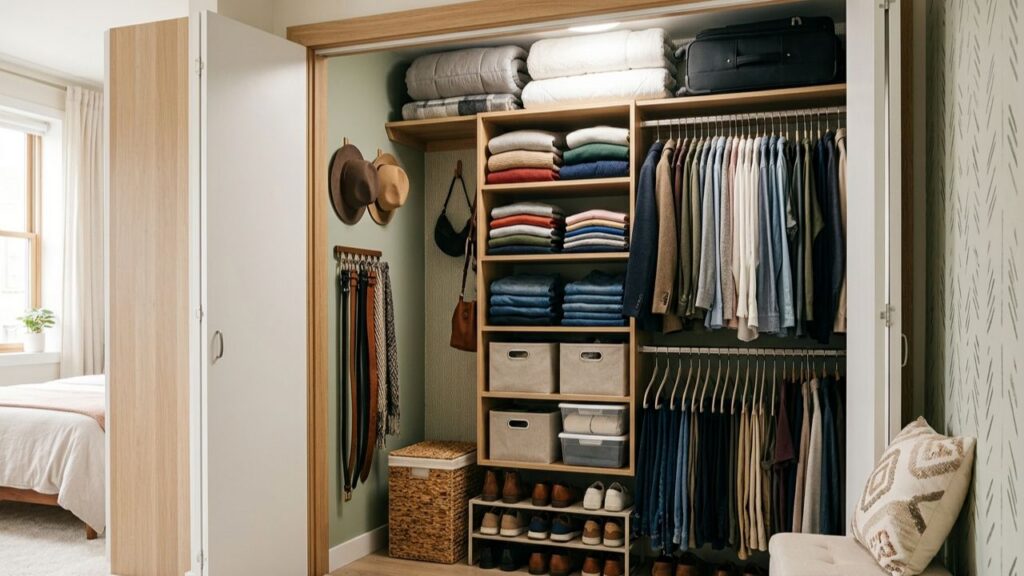
The good news? This is one of the most satisfying organizing projects there is. A reach-in closet that actually works changes your mornings. And it does not require a renovation to get there.
Why Reach-In Closets Fail
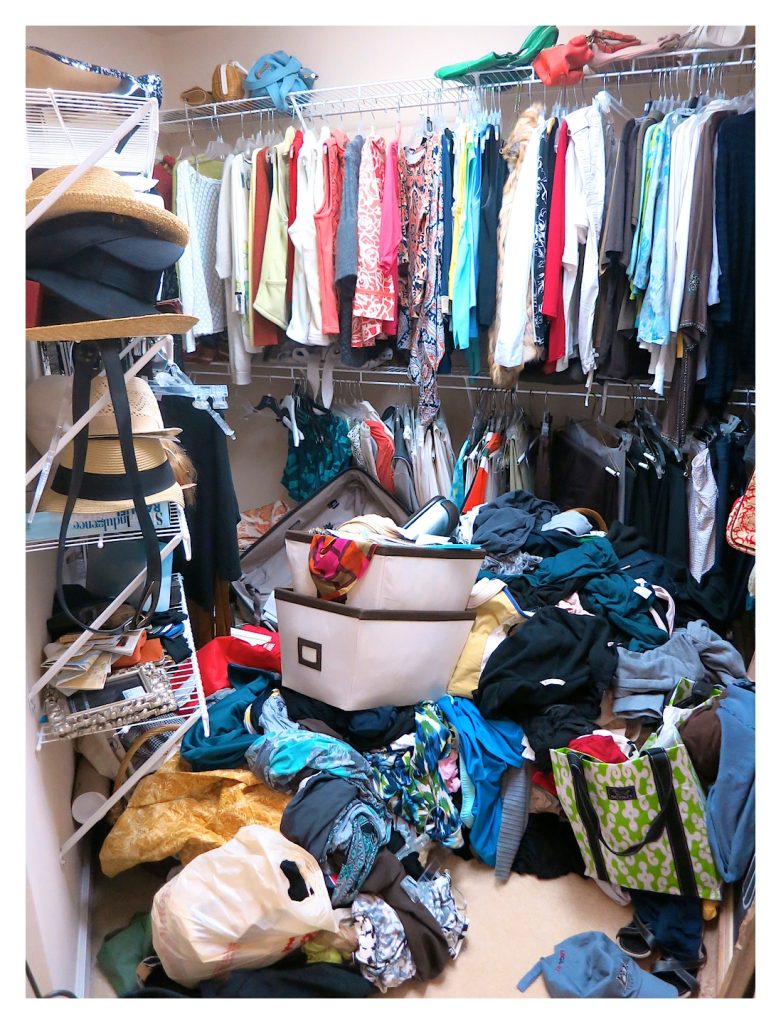
The problem is almost never the size of the closet.
It is the way the closet is set up — usually one hanging rod, one shelf above it, and nothing else. That single rod becomes the default home for everything that can hang, which means it gets packed so tightly that clothes get wrinkled, pushed to the back, and forgotten. The shelf above fills up with things that are hard to reach and therefore never touched. The floor becomes a pile.
The closet is not failing you. The system is failing you. And the system can be changed.
Step One: Take Everything Out
Before you change a single thing about the closet itself, everything comes out.
This is non-negotiable. You cannot properly assess a closet from the inside. You need to see what you are actually working with — not the version of the closet where things are pushed to the back and hidden from view, but every single item laid out where you can see it.
Group everything by category as it comes out. All tops together. All bottoms together. All shoes together. All bags together. This is the Assess step — and it works in a closet exactly the way it works everywhere else. You cannot make good decisions about what stays and what goes until you can see the full picture.
Step Two: Let Go of What Is Not Earning Its Space
A reach-in closet has limited space. Everything in it needs to earn that space.
Here is the honest question for each item: if you were shopping right now, would you buy this? If the answer is no — if it does not fit, does not flatter, has not been worn in a year, or is being kept out of guilt rather than use — it does not go back in.
I say this with complete kindness and zero judgment: most of us are keeping things we will never wear again. The dress that cost too much to get rid of. The jeans that will fit again someday. The gift from someone you love that is not your style at all. I have heard every version of every reason, and I get it. These are not easy decisions.
But here is what I know from years of doing this work. The moment those things leave the closet, people feel lighter. Not just organizationally — genuinely lighter. Because every item you do not wear but keep anyway is a small, quiet source of stress every time you open that door.
A smaller wardrobe of things you actually love is not a compromise. It is an upgrade.
Step Three: Maximize the Vertical Space
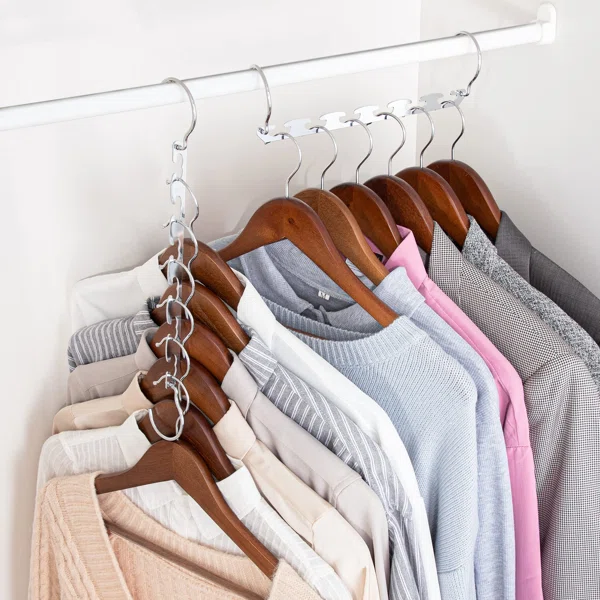
Most reach-in closets are set up to use only about 40% of their available space. The rest is wasted.
Here is how to use all of it.
Double hang where you can. If you have a section of the closet with shorter items — shirts, jackets, folded trousers — you can add a second hanging rod below the first. This immediately doubles the hanging capacity in that section without changing the closet structure at all. Or, you can use multi-garment hangers, which require no extra DIY work at all!
Add a second shelf. The space above the top shelf is almost always completely unused. Adding a second shelf up there creates storage for items you do not need frequently — seasonal pieces, spare bedding, bags you only use occasionally.
Use the floor intentionally. The floor of a reach-in closet should not be a dumping ground. A shoe rack, a small set of drawers, or a single bin for gym bags uses the floor space deliberately instead of letting it become the catch-all zone.
Add hooks to the inside of the door. The back of a closet door is valuable real estate. Hooks for bags, scarves, belts, or jewelry take things off shelves and rods and put them somewhere accessible and visible.
Step Four: Organize What Stays by How You Actually Use It
Once you know what you are keeping and you have maximized the space, everything goes back in a specific, intentional order.
Daily items at eye level and arm’s reach. The things you reach for every day — your most-worn tops, your everyday shoes, your go-to bag — should be the easiest things to access. Not buried, not at the top, not on the floor. Right there.
Seasonal items out of the prime zone. Winter coats in summer, summer dresses in winter — these go up high or toward the back. They are not gone, they are just not taking up the most accessible space.
Like with like. All tops together, organized by color or sleeve length depending on how you think about your wardrobe. All bottoms together. Shoes paired and facing the same direction. When everything is grouped logically, getting dressed in the morning becomes significantly faster.
Fold what does not need to hang. T-shirts, jeans, knitwear — these do not need to be on hangers. Folding them and storing them on shelves or in drawers frees up hanging space for the items that genuinely need it.
The One Purchase Worth Making
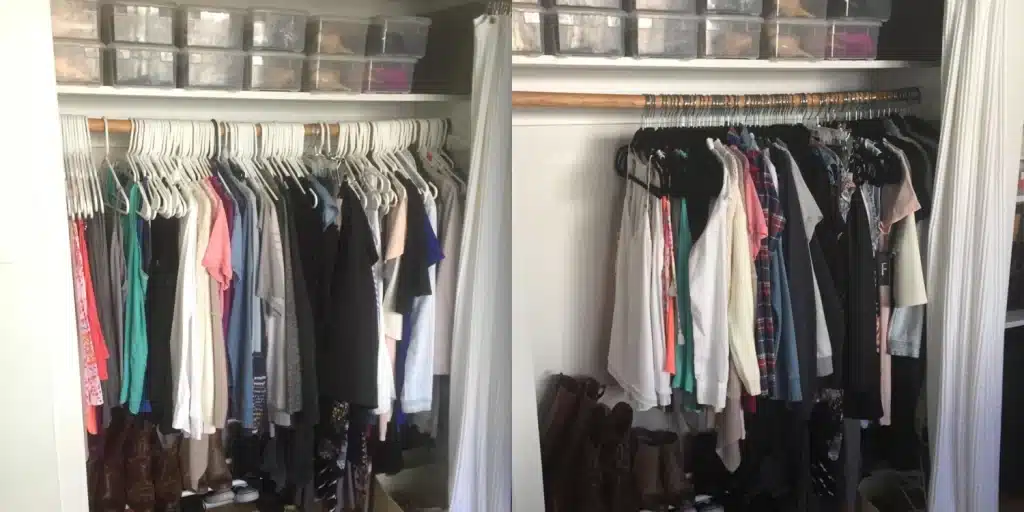
If there is one thing worth investing in for a reach-in closet, it is matching slim velvet hangers.
This is not an aesthetic suggestion. Slim velvet hangers take up significantly less horizontal space than plastic or wire hangers, which means more items fit on the same rod. The velvet prevents things from slipping. And because they are all the same, the closet looks more organized even before you have done anything else.
A full set costs less than most storage solutions and has more impact than almost any of them.
What to Skip
Before you buy anything else, a word on what not to buy.
Do not buy storage solutions before you have done the declutter. This is the most common organizing mistake — buying bins and dividers and shelf systems for a closet that still has 40% of its contents heading to the donation pile. You will buy the wrong amount of the wrong things.
Do not buy a closet organization system online based on measurements alone. Measure twice, but also think about how you use the space. A system optimized for shoes when you mostly need hanging space does not help you.
And do not reorganize around the things you do not wear. Every system you build should be built around the wardrobe you actually have — not the aspirational version, not the things you are keeping just in case. The wardrobe you actually reach for every morning.
If you have a reach-in closet that has never quite worked, and you are ready to make it actually functional, that is exactly what I do.
Book a session here, call 832-271-7608 to get started even faster, or, if you still have questions, complete the form below. I’ll answer them as quickly and completely as possible.

Working with Taya and her team is easy. You can book an appointment easily on her website, or contact her directly at 832-271-7608
- How to Organize Your Fridge and Freezer Before Thanksgiving - October 23, 2026
- How to Set Up Your Guest Room Before Holiday Guests Arrive - October 19, 2026
- How to Organize Your Hall Closet Before Holiday Guests Arrive - October 16, 2026