
| Getting your Trinity Audio player ready... |
OK friend, we need to talk about your fridge.
I know, I know — it’s not the first place anyone wants to start. It’s cold, it’s a little intimidating, and honestly sometimes it’s easier to just close the door and pretend everything in there is fine.
But here’s the thing: the fridge is one of the spaces I see go wrong in almost every home I work in. And almost always for the same reasons. Not laziness. Not carelessness. Just habits that seemed fine until they weren’t, and a few pieces of advice floating around the internet that are genuinely, factually wrong.
So before you pull everything out and start fresh — and yes, I absolutely want you to pull everything out — let’s make sure you know what not to do first. Because some of these mistakes are ones I’d bet you’re making right now without even realizing it.
1. Overfilling it. Or underfilling it.
Both extremes cause problems, which surprises most people.
An overfilled fridge blocks air vents, impedes circulation, and makes it almost impossible to see what you have. Things get pushed to the back. Things expire. Things become unidentifiable. If it feels like something might fall out every time you open the door, that’s not a storage problem — that’s a declutter problem, and the Calm Home Declutter Method™ applies here just as much as it does anywhere else in your home.
An almost-empty fridge has its own issue: without enough mass to hold the cold, temperatures fluctuate more. A simple fix is keeping a few bottles of water in there — chilled water helps maintain a consistent temperature even when the shelves are sparse.
The sweet spot is about two thirds full.
2. Washing and cutting produce before you store it.
I know this one is everywhere. The idea is that pre-cut vegetables encourage healthy snacking — especially for kids — and I understand the logic. But here’s the reality: cut produce deteriorates significantly faster because more surface area is exposed to air.
Wash and cut when you’re ready to eat, not before. Your produce will last longer, and you’ll waste less.
3. Storing milk and eggs in the door.
The door is the warmest part of your fridge — temperatures fluctuate every time it opens. Milk spoils faster in warm spots. So does anything else that’s sensitive to temperature changes, including eggs.
Milk belongs on the middle shelf, where temperatures are most consistent. Eggs too — and if your fridge has a dedicated egg compartment in the door, ignore it. That’s a legacy design feature that hasn’t made sense for decades.
The door is for condiments — ketchup, mustard, hot sauce, anything high in vinegar or salt that can tolerate the temperature variation. If something needs to stay consistently cold to stay safe, it doesn’t belong there.
4. Mixing fruits and vegetables in the same drawer.
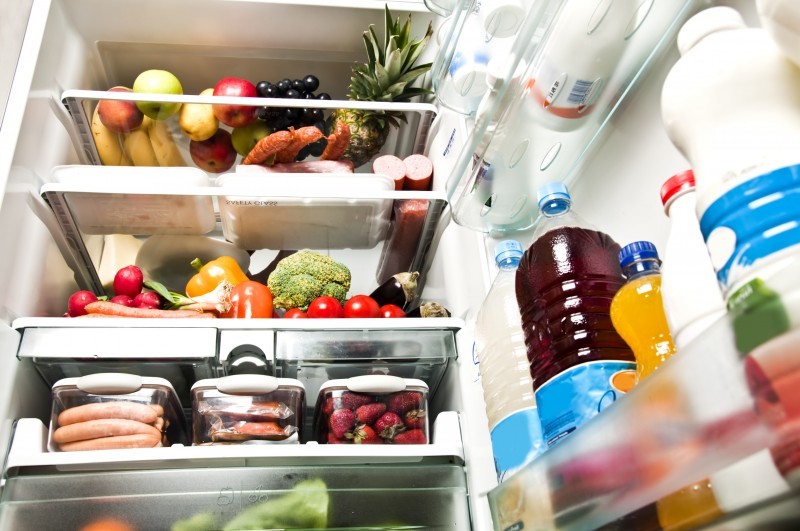
If your fridge has two crisper drawers, they’re not interchangeable. The vegetable drawer is calibrated for high humidity — greens need moisture to stay crisp. The fruit drawer is calibrated for low humidity — fruit rots faster with too much moisture.
Beyond humidity, there’s a science reason to keep them separated: many fruits produce ethylene gas, which accelerates ripening in nearby produce. Put ethylene-producing fruit next to your vegetables and your greens will deteriorate faster than they should.
One exception worth knowing: strawberries. Despite being a fruit, they do better in the vegetable crisper — they like humidity, they don’t tolerate ethylene well, and they’ll last noticeably longer over there. Just don’t wash them before storing.
5. Storing meat anywhere but the bottom shelf.
Raw meat belongs on the lowest shelf, always. It’s the only place it can’t drip onto anything below it.
Put a tray or rimmed plate underneath it while you’re at it — it contains any leaks and makes cleanup straightforward if something does go wrong. It’s a small habit that prevents a big problem.
6. Not using bins, trays, and containers.
The same principle that makes bins work in a pantry or a closet works in a fridge. A container gives a category a home. A home means things go back where they belong. Things going back where they belong means you can see what you have — and visibility is the whole point.
An “Eat Me First” bin is one of my favorite fridge additions — it’s a designated spot for anything that’s close to its use-by date. When it’s visible, it gets eaten. When it’s pushed to the back of a shelf, it becomes the thing you discover three weeks later and feel guilty about.
A lazy Susan works well for condiments that don’t fit in the door. A tray under the meat. A colander for citrus — it keeps the airflow going and separates it from ethylene-sensitive produce.
None of this needs to be expensive or matching. It just needs to have a logic.
7. Treating the fridge as somewhere food goes to disappear.
This is the one that costs people the most — in money, in waste, and in the low-level stress of never quite knowing what’s in there.
According to research from Johns Hopkins University, somewhere between 31 and 40 percent of the American food supply goes to waste. A significant portion of that happens in the home, and a significant portion of that happens because fridges aren’t organized in a way that makes their contents visible.
An organized fridge — one where everything has a place, where things go back where they belong, where you can see what’s there at a glance — is one of the fastest ways to reduce food waste and genuinely save money. That’s not a small thing.
The fridge is a good place to practice the Calm Home Declutter Method™ if you’ve never worked through it before. Clear the obvious first — expired items, things that shouldn’t be in there, anything that’s past saving. Then assess what you actually have by grouping it. Then let go of what doesn’t belong or isn’t going to get used. Then map it — give everything a home, in the right zone, with the right logic.
It takes less time than you think. And once it’s done, the Calm Home Reset Method™ keeps it there — a weekly five-minute check of what’s running low, what needs to move to the front, and what needs to go.
If you want help getting there — or if the fridge is just one corner of a home that needs a proper reset — I work with clients in person in Houston and virtually from anywhere.
Book a session here, call 832-271-7608 to get started even faster or, if you have more questions first, complete the form below, I’ll answer them as quickly and completely as possible.

Working with Taya and her team is easy. You can book an appointment easily on her website, or contact her directly at 832-271-7608
- Why an Organizing Plan From an App or AI Falls Apart in a Houston Home - October 12, 2026
- How to Organize Your Baking Supplies Before the Holiday Baking Starts - October 9, 2026
- How to Organize a Nightstand: What Goes on Top, in the Drawer, and Behind It - October 7, 2026