
| Getting your Trinity Audio player ready... |
Hey friend, back-to-school season has a way of making everyone feel like they should have a Pinterest-worthy homework station ready to go — corkboard, matching bins, a cute little “assignment tracker” with a color-coded key nobody will ever actually use. Then you look at your actual kitchen table, currently covered in backpacks, three unopened folders, and what might be a permission slip from last May, and it’s easy to feel like you’re already behind before the first spelling test even happens.
You’re not. That gap between the Pinterest version and your kitchen table isn’t a sign you’re failing at back-to-school. It just means the Pinterest version was never built for a real Tuesday.
The good news is a homework space doesn’t need to be beautiful to work — it just needs to survive contact with an actual kid on an actual bad day.
It Doesn’t Need to Be a Room. It Needs to Be a Spot.
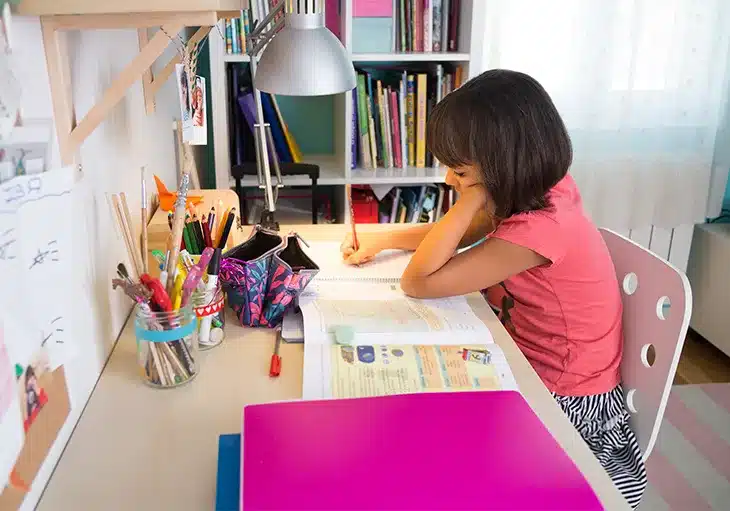
A dedicated homework room sounds nice, but for most families it’s about as realistic as a house that stays clean on its own. What actually matters is one consistent spot, even if it’s just one end of the kitchen table or a corner of a shared space. Consistency does more work than square footage. A kid who knows “this is where homework happens” settles into the task faster than one who’s re-deciding where to sit every single afternoon, like it’s a hard problem that needs to be solved from scratch each day.
If your only available spot doubles as a dinner table, that’s genuinely fine. The spot doesn’t have to be permanent, or impressive. It just has to be predictable.
When Multiple Kids Need the Same Table
If more than one kid is competing for the same table at the same time, that’s not a sign your system is broken — it’s a scheduling conflict that happens to be sitting on top of a desk. A staggered start (younger kid first, since younger homework is usually shorter, older kid after) solves more of this than any amount of extra desk space would. If staggering isn’t realistic, splitting the table down the middle with each kid’s own caddy on their own side at least removes the daily argument over whose stuff is whose.
The goal isn’t eliminating every bit of sibling friction. It’s making sure the friction is about something real — a shared resource at a busy hour — and not about a system that never accounted for more than one kid using it.
One Portable Caddy Beats a Fully Stocked Desk
Instead of trying to outfit a whole desk with every possible supply, put the basics — pencils, an eraser, a sharpener, a ruler, a couple of highlighters — in one small caddy or pencil case that travels with your kid wherever homework actually happens. This solves two problems at once: nobody’s tearing the house apart for a working pencil at 6pm, and the “station” isn’t tied to one piece of furniture that has to be free and clean on demand.
A caddy also makes the reset simple. Everything goes back in one container, not back into a dozen individual desk slots you’ll be re-teaching every September.
Don’t Forget the Charger
Most homework today runs through a laptop or tablet, not just a notebook, and a dead Chromebook derails an evening faster than a missing pencil ever could. The fix is the same logic as the supply caddy: one consistent spot where the device, its charger, and headphones live when they’re not in use — not “somewhere in the backpack” or “wherever it was last plugged in.”
A single outlet strip or charging station near the homework spot solves most of this. So does a simple household rule: device goes back to its spot, plugged in, the moment homework’s done — not after dinner, not “later.” That one habit prevents most of the 6:45am scrambles to find a charger before the bus.
If forgotten logins and passwords are a recurring issue, a small notecard taped inside the caddy lid with usernames (never full passwords, just enough to jog memory) saves a surprising amount of nightly friction too. And as a parent keeping the full logins in a secure app on your own devices is a big help too.
Let Your Kid Make the Small Decisions
This is the part that gets skipped most often: a homework space a kid had a say in tends to get used more than one that was designed and imposed for them. That doesn’t mean handing over the whole plan — it means giving them real, small choices inside a structure you’ve already set. Which caddy to use. Which chair. Whether the pencils are sharpened at the start or the end of homework time. Small decisions, genuinely theirs.
This matters for older kids especially, though let’s be honest about what “matters” actually buys you here — a tween or teen who helped choose their own setup isn’t suddenly going to maintain it flawlessly, or ever, possibly. But the odds genuinely go up when it’s something they picked instead of something imposed on them, and with a teenager, better odds is often the whole win.
Keep What’s Visible to a Minimum
A homework spot covered in supplies, half-finished worksheets, and old folders creates the same kind of quiet mental drag as any cluttered space — more to look at, more to make a decision about, more reasons to feel overwhelmed before the actual homework even starts. You don’t need an empty table. You need one that isn’t visually shouting at your kid the moment they sit down.
A simple rule that helps: only the caddy and the current assignment stay out. Everything else — other subjects’ folders, yesterday’s papers, unrelated supplies — has a spot that isn’t the workspace itself.
Build In a 2-Minute Reset, Not a Deep Clean
The habit that actually keeps a homework spot usable isn’t a big weekly cleanup. It’s a small, consistent reset at the end of each session — caddy closed and put away, finished papers into a single landing spot (the same “one bin” idea that works everywhere else in the house), backpack repacked for the next day. Two minutes, done while everyone’s already there, instead of a bigger cleanup nobody has energy for later.
Like anything else, this works best if it’s simple enough for your kid to actually do themselves — though “simple enough” and “a teenager will do it unprompted” are two different things, and only one of those is something a system can actually guarantee. The realistic goal is lowering the odds this quietly becomes your job by default, not expecting it to run itself.
It’s Allowed to Look a Little Messy
A homework space that gets used every day is going to look lived-in, eraser shavings and all, and that’s not a failure — it’s a sign it’s actually working. The goal was never a spotless setup for the sake of a photo nobody’s taking anyway. It was a spot low-friction enough that your kid sits down and starts, most days, without a fight about where things are or what’s missing.
If you’ve tried a few homework setups already and none of them have stuck, that’s usually not a sign you need a better Pinterest board — it’s a sign the setup needs a second pair of eyes on what’s actually happening in your house, not what’s supposed to happen in theory. I help families build homework spaces (and every other space) around how your kid actually works, not how the internet says they should.
As a decluttering expert and professional organizer I work with clients in person across the Greater Houston area and virtually from anywhere.
Book a session here, call 832-271-7608 to get started even faster, or, if you still have questions, complete the form below. I’ll answer them as quickly and completely as possible.

Working with Taya and her team is easy. You can book an appointment easily on her website, or contact her directly at 832-271-7608
- How to Organize Your Fridge and Freezer Before Thanksgiving - October 23, 2026
- How to Set Up Your Guest Room Before Holiday Guests Arrive - October 19, 2026
- How to Organize Your Hall Closet Before Holiday Guests Arrive - October 16, 2026