
| Getting your Trinity Audio player ready... |
Hey friend, let’s talk about what’s under your bed.
Not to make you feel bad about it. I promise. But because under the bed is one of those spaces where everyone — every organizer, every home blog, every storage solutions ad — tells you the same thing: use it. Store things there. It’s dead space, they say. Maximize it.
And then they stop. They tell you to use it and leave you to figure out the rest. Which is why so many people either stuff random things under there and call it organized, or leave it completely empty because they tried a system once, and it didn’t hold.
Here’s what nobody tells you: under the bed storage has rules. And when you don’t know the rules, the space either becomes overflow chaos or wasted potential. Both are a problem I see constantly.
After years of working in bedrooms, I have a very clear sense of what belongs under a bed, what doesn’t, and why most under-bed organization systems fall apart within three months of being set up.
Why Under-Bed Storage Fails
Before we talk about what to put there, let’s talk about why it so often doesn’t work.
The most common mistake is treating under the bed as overflow storage. A place for things that don’t have a home anywhere else. The extra throw pillows. The boxes from things you bought months ago and kept just in case. The stuff that was supposed to be temporary and became permanent.
When under the bed becomes overflow, two things happen. First, you lose track of what’s there. Out of sight, out of mind — and things that are out of mind don’t get used, maintained, or reconsidered. Second, retrieval becomes a problem. If everything is in mismatched boxes pushed back as far as possible, getting to anything requires pulling everything out. Which means you stop trying. Which means the space stops working entirely.
The second most common mistake is buying under-bed storage containers before deciding what goes in them. The containers look organized. But if what’s inside them isn’t intentional, the containers are just making the chaos look neater.
What Actually Belongs Under the Bed
Under the bed storage works best for things that share three characteristics: they are used seasonally or occasionally, they are reasonably flat or compressible, and they belong in the bedroom.
That last point is important. Under the bed is bedroom storage. It is not an extension of the garage, the attic, or the hallway closet. When bedroom-adjacent items live under the bed, the system makes sense and retrieval is natural. When random household overflow lives there, the system collapses.
Seasonal clothing and bedding. This is the single best use of under-bed space. Winter sweaters in summer, summer clothes in winter, the extra set of bedding that only comes out for guests — all of these are bedroom-adjacent, seasonal, and flat enough to store properly. Vacuum storage bags are your best friend here. They compress bulky items significantly and protect against dust and moisture.
Extra pillows and duvets. If you have more bedding than fits in your linen closet, under the bed is a logical home for the overflow — as long as it is in a proper breathable storage bag, not just pushed under loose.
Shoes you wear occasionally. Not your everyday rotation — those belong in your closet where you can see them. But the heels you wear a few times a year, the boots that only come out in winter, the formal shoes waiting for the next event — these are good candidates for under-bed shoe storage, ideally in clear boxes so you can see what you have without pulling everything out.
Gift wrap and wrapping supplies. This is a less obvious one, but it works remarkably well. Flat under-bed bags designed for wrapping paper keep everything in one place and get it out of a closet where it has no business being.
What Does Not Belong Under the Bed
Anything you use regularly. If you are pulling something out from under the bed more than once a month, it needs a more accessible home. Under the bed is not convenient storage — it is seasonal or occasional storage. Anything that requires frequent access will create the pull-everything-out cycle that makes the space feel like more trouble than it’s worth.
Boxes from purchases. I know. They feel useful. They are not. An empty box from a pair of shoes or a piece of technology is not storage. It is clutter. Let it go.
Random overflow. If something does not have a category, does not belong in the bedroom, or is under the bed because it has no home anywhere else — it does not belong there either. Under the bed is not the solution to a decluttering problem. The Calm Declutter Method™ comes first. Then you figure out storage.
Anything that attracts pests or moisture. Food — obviously. But also anything that is already damp, anything in cardboard that could become a home for insects, or anything that has been under there so long you are not sure what condition it is in.
The Rules for Making It Actually Work
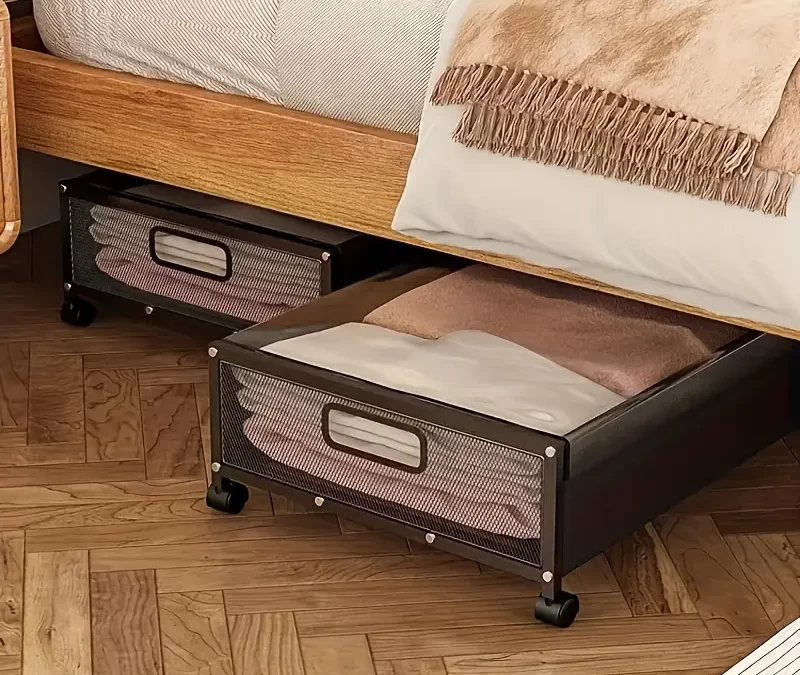
Clear containers only. If you cannot see what is in it without pulling it out, you will stop using the system. Clear, flat, lidded containers are non-negotiable for under-bed storage. The ones with wheels are even better. You should be able to look under the bed and know exactly what is there.
Label everything. Even clear containers get labeled. “Winter sweaters.” “Guest bedding.” “Occasion shoes.” Labels mean that anyone in the household can find and return things without a conversation.
Leave a gap at the front. Do not push containers all the way to the wall. Leave six inches or so of clear space at the front edge. This makes everything significantly easier to access and reminds you not to push random things under there to fill the space.
Reassess seasonally. Under-bed storage works on a seasonal rotation. Twice a year — at the beginning of summer and the beginning of winter — pull everything out, reassess what is there, and swap the seasonal items. This is a fifteen-minute job when the system is working properly.
Match the height to your bed. This sounds obvious but it matters. Measure the clearance under your bed before buying any storage solution. Platform beds have very little clearance. Higher beds can accommodate more. The wrong container for your bed height means either wasted space or things that do not fit.
One More Thing
If you pull everything out from under your bed right now and find things you forgot were there, things you have not thought about in months or years, that is not a storage problem.
That is a declutter problem. And the answer is not a better container system. The answer is the Calm Home Declutter Method™: clear what is obviously not needed, assess what is left, let go of what is not earning its space, and then — and only then — map the storage system around what remains.
Under the bed storage done right is genuinely useful. Under the bed storage done wrong is just a place where things go to be forgotten.
If you are ready to make every space in your home work properly, including the ones nobody else looks at, that is exactly what I do.
Book a session here, call 832-271-7608 to get started even faster, or, if you still have questions, complete the form below. I’ll answer them as quickly and completely as possible.

Working with Taya and her team is easy. You can book an appointment easily on her website, or contact her directly at 832-271-7608
- Kids’ Closet Organization: How to Handle Outgrown Clothes - September 28, 2026
- How to Organize a Home When You Live Alone - September 25, 2026
- What’s Your Organizing Personality Type? (Take the Quiz!) - September 23, 2026