
| Getting your Trinity Audio player ready... |
Before we start — I want to be clear about something. I’m not a cleaner. I don’t clean houses. I never have. That’s a completely different profession and those folks work incredibly hard.
What I do is figure out why your house fights you every time you try to clean it, organize it, or keep it together for more than a few weeks. And spring is when everything I do becomes the most visible — because spring is when people try to clean and discover what’s actually going on underneath.
So if you invited me over right now — before you spring cleaned a single room — here’s what I’d be looking at. Not to judge. To diagnose.
The First Thing I Notice Isn’t What You’d Expect
Most people think I’d walk in and look at the messiest room. The kitchen counter. The junk drawer. The closet that won’t close.
I don’t. The first thing I look at is your flat surfaces.
Every flat surface in your home tells me a story. Kitchen counters. Dining tables. Nightstands. The top of your dresser. That little table by the front door.
When flat surfaces are covered, it’s not because you’re messy. It’s because the items on those surfaces don’t have anywhere else to go. Or they do, technically, but getting them there requires too many steps. So things land on the nearest flat surface and stay.
If I walked into your home right now and every counter and table had a layer of stuff on it, I’d already know something specific: your storage isn’t matching your daily life. The things you use every day don’t have easy, obvious homes. And that one issue is probably responsible for about 70% of the visual chaos in your house.
That’s not a cleaning issue. You could clear every surface today and they’d be covered again within a week. Because the reason they got covered hasn’t changed.
The Kitchen Tells Me Everything

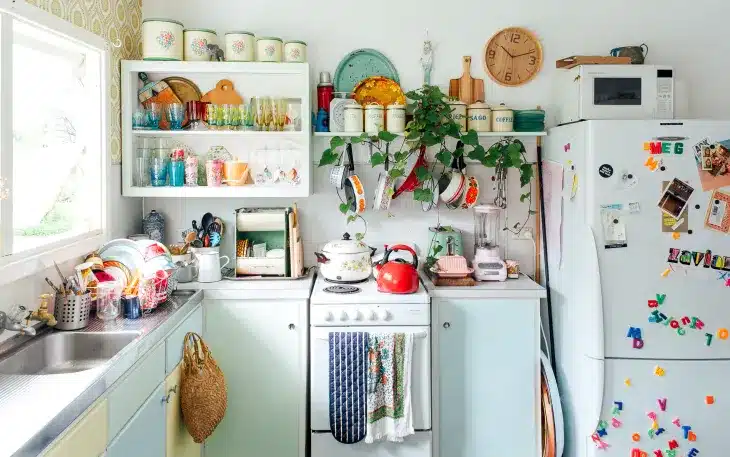
If I could only walk one room before you spring cleaned, it would be the kitchen. Not because it’s the dirtiest. Because it’s the most honest.
Your kitchen can’t hide its problems. It’s the highest-traffic room in the house. Every person in the household passes through it multiple times a day. It produces mess constantly — cooking, eating, storing, prepping. If systems are working, the kitchen recovers quickly. If they’re not, the kitchen shows it immediately.
Here’s what I’d look at:
The counters. What’s sitting on them? If it’s appliances you use daily — coffee maker, toaster — that’s fine. If it’s mail, keys, school papers, random items that migrated from other rooms, bottles that should be in cabinets but the cabinets are full — that’s a system problem. Your counters have become storage because the actual storage isn’t working.
The pantry. I’d open it. I wouldn’t be looking at how neat it is. I’d be looking at how deep it goes. How many items are behind other items? How many things expired back there because they got pushed to the back and forgotten? In Houston specifically, I’d be looking at pest evidence — because a crowded pantry with expired items in a humid climate is an invitation.
Under the sink. This is one of the most diagnostic spaces in any Houston home. It’s small, it’s awkward, it’s usually overstuffed, and everyone just shoves things in there and closes the door. If under your sink is chaos, it’s telling me that your cleaning supplies don’t have a system — which means the actual cleaning is harder than it needs to be. You can’t clean efficiently when you can’t find what you’re cleaning with.
The drawers. Not the organized ones. The one you’re embarrassed about. Every kitchen has at least one drawer that’s basically a junk catchall. That drawer is telling me your kitchen doesn’t have a decision framework for small items. Batteries, takeout menus, twist ties, random hardware, coupons, pens — they all end up in the same place because there’s no better place for them.
What the Closets Are Hiding
I’d open your main closet. And before you panic — I’m not looking at whether things are color-coordinated or perfectly folded. I don’t care about that.
I’m looking at capacity. Is the closet at 100%? Is there any breathing room at all? Are things crammed in so tight that pulling one item out disturbs everything around it?
Because here’s what a closet at capacity means: there’s no room for the decision-making process. You can’t edit what you own if there’s no space to spread things out. You can’t rotate seasonal items if every inch is taken. You can’t put clean laundry away easily if the shelves and rods are maxed out.
A closet at 100% capacity isn’t organized. It’s full. And full closets are why people dread “cleaning out” their closet every spring — because they know it means pulling everything out with nowhere to put it while they sort.
I’d also look at what’s on the floor of the closet. Shoes in a pile? Items that fell off shelves and were never picked up? Bags of clothes you meant to donate? The closet floor tells me the same thing the garage floor tells me — where the system broke down.
In Houston, I’d also check if seasonal items are taking up prime closet space. We don’t have dramatic seasons, but we do have a shift. And a lot of people are dedicating year-round closet real estate to heavy coats they wear twice a year. That’s space that could be serving you better.
The Bathroom Cabinet Test
Open the cabinet under your bathroom sink. Or the medicine cabinet. Or wherever you store your daily products.
Are there items in there you haven’t used in six months? A year? Products you bought, tried once, didn’t like, but kept “just in case”? Expired medications? Travel-size bottles from three trips ago?
That’s not dirty. That’s not messy. That’s a space that hasn’t been evaluated in a long time. And when it’s time to spring clean the bathroom, all of that has to be dealt with before you can even wipe the shelves.
The bathroom is one of the fastest rooms to actually clean. But one of the slowest to spring clean — because the storage is usually packed with decisions that got deferred.
I see this constantly. Someone tells me their bathroom took four hours to spring clean. The scrubbing took maybe fifteen minutes. The rest was going through every product, every bottle, every item, and figuring out what to keep, what to toss, and what to do with things that are expired or unwanted. That’s organizing. That’s not cleaning.
The Rooms Nobody Mentions
When people call me about spring cleaning overwhelm, they usually mention the kitchen, the closets, maybe the garage. They almost never mention these spaces — but I always look at them:
The entryway. Where do things land when you walk in the door? Shoes, keys, bags, mail, jackets. If the entryway doesn’t have a system, clutter starts accumulating the moment you walk in. And it radiates outward from there.
The laundry area. Not the machine itself — the flow. Where does clean laundry go when it comes out of the dryer? If it goes to a bed, a chair, or a basket where it sits for three days before being put away, that’s not a laziness issue. That’s a flow issue. The path from dryer to closet or drawer has a bottleneck somewhere, and until that’s fixed, laundry will always pile up.
The guest room or spare room. In a lot of Houston homes, this has become the “catch-all” room. The room where things go when they don’t have a home anywhere else. If you have a room like this, it’s the single biggest indicator that your home’s systems are overloaded. That room isn’t a guest room. It’s a symptom.
What This Walk-Through Would Tell Me
If I did this walk-through in your home — fifteen minutes, no cleaning, just looking — I’d be able to tell you:
Where your storage is failing. Which rooms are bearing the burden of other rooms’ overflow. Where decision-making has been deferred the longest. What your daily flow is and where it breaks down. Whether your home is set up for the life you’re living now or the life you were living three years ago.
None of that requires a mop. All of it explains why spring cleaning feels like it takes forever.
Why This Matters Before You Spring Clean
I’m not telling you all of this to make you feel bad about your house. Your house is fine. You’re fine.
I’m telling you because if you’re about to spend an entire weekend spring cleaning, I want you to get more than a temporary reset out of it. I want you to understand what you’re actually dealing with — so the effort you put in this spring actually lasts.
Because the truth is, most spring cleaning fails not because people don’t clean hard enough. It fails because the organizational problems underneath are still there when the cleaning is done. And within weeks, everything drifts back to where it was.
If even one of the things I described — the covered surfaces, the packed closets, the catch-all room, the pantry with expired items in the back — sounded familiar, that’s not a cleaning issue waiting for spring. That’s a structural issue that’s been building for a while.
And it might be worth addressing before you pick up the cleaning supplies.
When You’re Ready
If this walk-through hit a little too close to home, let’s talk. I’ll do an actual diagnostic — in person in Houston or virtually anywhere — and we’ll figure out what your home needs before spring cleaning season makes it all feel urgent.
Because the best spring clean you’ll ever do is the one where you barely have to clean — because the organization underneath is already working.
Schedule your consultation here or call 832-271-7608.
Serving Houston in-home & virtual organizing sessions anywhere.
Restoring Your Sanity, Clarity & Time™

Working with Taya and her team is easy. You can book an appointment easily on her website, or contact her directly at 832-271-7608
- Kids’ Closet Organization: How to Handle Outgrown Clothes - September 28, 2026
- How to Organize a Home When You Live Alone - September 25, 2026
- What’s Your Organizing Personality Type? (Take the Quiz!) - September 23, 2026