

INCLUDING FREE PRINTABLE TEMPLATES!
Even the most frantic individual could become a god of organized productivity by using a bullet journal. Sounds like a lofty goal? Bullet journaling is more than a trendy fad, it actually works.
After a few chaotic years that frequently derailed everyone’s plans and objectives, you might love this planning method in 2023. It entails grouping notes, events, chores, and plans into organized collections and records. And it ‘gameifies’ things – a buzzword for makes things more fun – so you are far more likely to stick with it.
So What is a Bullet Journal?
According to the Bullet Journal Method website, bullet journaling is “best described as a mindfulness practice disguised as a productivity system.”
It was designed by someone who had struggled with organization and productivity all their life. After discovering that no existing systems actually worked for him, author and product designer Ryder Carroll, who was diagnosed with learning difficulties as a child, created the Bullet Journal Method as a way to plan, organize, and focus. And a lot of people have discovered that it works for them too.
The Benefits of Keeping a Bullet Journal
Because it places a strong emphasis on visual organization, the bullet journal method may be simpler for some people to utilize than other planning techniques.
As a result, you may be required to maintain less information in working memory, the area of the brain responsible for mentally juggling a variety of elements. Additionally, it can make it simpler to organize the specifics so you can “right the ship” if your original plan needs to be modified.
Overall, bullet journaling can help you combat procrastination by making your task list seem less overwhelming. Thus, the bullet journal method might be useful for you if you have trouble being productive and efficient.
How is a Bullet Journal Different From a Standard Journal?
The main difference between bullet journaling and regular journaling is that bullet journals tend to be “more concise and visually streamlined. Rather than an “anything goes” approach, the bullet journal method employs an organized system designed to keep notes, thoughts, to-dos, events and goals organized.
It’s more like very detailed and organized note-taking, versus the random thought streams you might write in a regular journal — a life planner versus a diary. And the fact that you can, if you choose – get very creative with it – you don’t have to though – may mean that you are far likely to stick with it, as it’s an activity you can look forward to rather than just another thing to do.
Getting Started with a Bullet Journal
Because your bullet journal is personalized for you and you can make it into whatever you need it to be, bullet journaling is rather simple. Despite the templates, (more on those in a moment) bullet journaling is an ordered process. You can put all the specifics of your life into one straightforward place with the aid of this imaginative yet guided technique.
The following tips will help you start your bullet journal.
Buy a Nice Notebook
Any notebook will do. Although the Bullet Journal Method sells “bullet notebooks,” you can buy any notebook you like. Find one you love with lined, dotted or graph paper. If you want to become one of those people who gets very visually creative with your bullet journal, start off with one that looks visually appealing. And if you plan to carry it around with you, try to choose one that’s durable.
Here are some I love that you can find on Amazon, including options with the cute markers/washi tape/stickers included to get you started off.


Important! Your notebook’s initial few pages should be blank. These pages are required to build your index, which is covered here later.
Decide What You’ll Be Bullet Journaling About
Do you need a complete life planner? A means to remind you stay in touch with your friends and family? A wedding planner? A fertility tracker? Many people use bullet journals for everything instead of using several notebooks or planners for different topics, but if you want to start out small, you can choose to make a bullet journal for just one topic, goal, or event.
Learn the Bullet Journal Key System
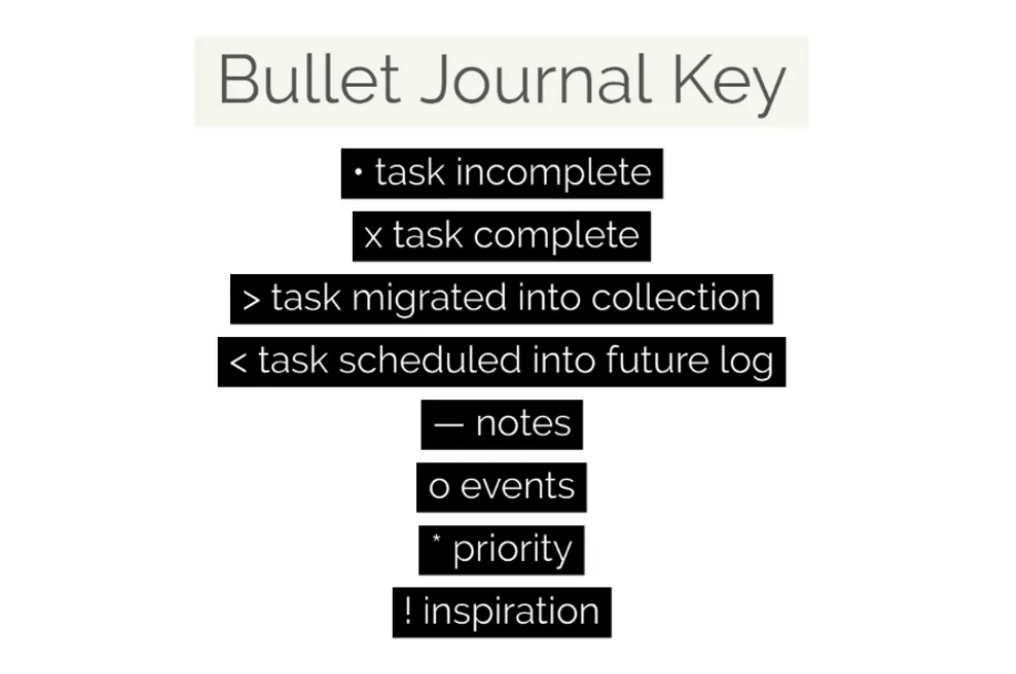
You’ll benefit most when you adhere to the official Bullet Journal Method, regardless of what you’re bullet journaling about. Tasks are where it all begins, and they are represented by dots. Change the dot into an X once you have finished a task. Turn the task into a “greater than” sign if you add it to a collection (more on collections below). You should change the dot to a “less than” symbol if you transfer the task to your future log.
An open circle denotes an event, while a dash denotes a note. Asterisks can be used to indicate the importance of tasks, notes, and events, and exclamation points can be used to indicate inspiration.
Here’s the key in short:
Start with a Future Log
Any objectives, activities, or events that fall outside of the current month should be included in your future log. Your future log should begin with the following month when you first start using a bullet journal.
If you begin bullet journaling in January, for instance, begin your future log with February. Keep a record of your travel arrangements, business commitments, objectives, and other vital details you don’t want to forget. Review your future log each month to see if you can transfer anything to the monthly log you’re using right now.
Set Up a Monthly Log
Everything significant that happens during a particular month is recorded in your monthly log. You could list weekend plans, upcoming deadlines, and important birthdays. Make a simple, list-style calendar to record important dates for each monthly log, as well as a task page for things you need to finish or catch up on from the previous month.
Create Your Daily Logs
Your daily log doubles as your to-do list for the day. The most crucial thing in this situation is that you don’t prepare your daily logs too much in advance. Because you may never be sure how much space a particular daily log would require, the Bullet Journal Method suggests making daily entries the night before or the morning of. Log your accomplished chores, as well as any thoughts or notes you have throughout the day.
It’s entirely up to you how much design and originality you put into your daily logs; you don’t have to make them look as pretty as those you’ll see all over Instagram, but if you do, you may find that it all becomes a hobby rather than a chore and you get more out of it.
The Daily Logs are where most people get very creative. You can keep things simple:

Or get very fancy:
Create That Index
Remember I told you to leave those first few pages of your chosen notebook blank? that’s because those are for the Index.
Indexing your bullet journal is simple. Just count the page ranges for your different sections and write them down, so you can easily leaf through your notebook later.
For example, if your future log runs from pages 10 to 14, write “Future Log: p. 10-14” in your index. Another option is to use sticky tabs or paper clips so you can easily find each section.
Add Collections Too
In the back pages of your bullet journal, make “collections” for everything that isn’t a task, an event, or a note. Collections can be anything, such as “books to read,” “recipes to try,” or “places to visit,” and they are broad objectives you wish to complete over the course of a year or more. Keep your bullet journal close at hand so you can record these ideas as they emerge.
Start Crossing Off Those Tasks
The rewarding part now is checking items off your to-do list. Cross off the things you finish each day, and group the ones you don’t. You can transfer tasks that haven’t been completed to a collection, your future log, or another day.
Try Some (Free) Just Organized by Taya Bullet Journal Templates
If you need some help getting your bullet journal set up, you can make use of templates. If you want to get started quickly, you can use the templates that we have created. Our bullet journal templates are free, easy to print and even pretty. There’s something for everyone, including index, future, month and daily log pages and more than 250 ideas for what to add to your daily pages and collections.
To get your free bullet journal templates, simply click here.

Working with Taya and her team is easy. You can book an appointment easily on her website, or contact her directly at 832-271-7608
- The Post-Christmas Reset: What to Do (and What to Skip) This Weekend - December 26, 2025
- The Week-Before-Christmas Survival Guide: Last-Minute Gift Organization Tips - December 18, 2025
- 7 Things in Your Kitchen Right Now That Need to Go - December 16, 2025