

| Getting your Trinity Audio player ready... |
Every spring, you tell yourself this is the year you’re finally going to deal with the closet.
You pick a Saturday. You clear the bed. You open the doors. You start pulling things out.
And then three hours later, you’re standing in your bedroom surrounded by piles of clothes, half of which are on the bed, a quarter on the floor, and you’re holding a blouse you haven’t worn in two years going “but what if I need this for something?”
You started with energy. Now you’re exhausted. The closet somehow looks worse than when you began. And you’re seriously considering just putting everything back where it was and pretending this never happened.
I love you. But we need to talk about what’s actually happening here. Because this isn’t a closet problem. And it’s definitely not a you problem.
Why the Closet Is the Room That Breaks People

I’ve been organizing closets in Houston for close to 20 years. And I’m going to tell you something that might surprise you: the closet is the space where more people give up during spring cleaning than any other room in the house.
Not the garage. Not the kitchen. The closet.
And it’s not because closets are harder to clean. It’s because closets don’t actually need cleaning. They need editing. And editing your wardrobe is one of the most emotionally loaded tasks in your entire home.
Every other room has stuff in it. Your closet has identity in it.
That shirt you bought when you got the promotion. The dress from that vacation. The jeans from before the baby. The jacket your mom gave you that you never wear but can’t let go of. The clothes from a version of your life that doesn’t exist anymore but still takes up space on the rod.
You’re not sorting laundry in there. You’re sorting through versions of yourself. And that is exhausting in a way that wiping down a kitchen shelf will never be.
The Pattern I See Every Single Spring
Here’s how it goes. Tell me if I’m wrong.
You pull everything out. This feels productive. You’re doing it. You’re really doing it this time.
Then the piles start. Keep. Donate. Maybe. And within thirty minutes, the maybe pile is twice the size of the other two combined.
Because “maybe” is where decisions go to die. Maybe I’ll wear this next season. Maybe I’ll fit into this again. Maybe this will come back in style. Maybe I’ll need this for an event. Maybe.
And then you hit the wall. You’ve been making decisions for an hour straight and your brain is done. Everything starts feeling important. Everything starts feeling like it might be needed. Your judgment gets fuzzy. The thought of making one more keep-or-toss decision makes you want to take a nap.
So you put the maybe pile back. Most of it goes right back where it was. You bag up the obvious donations — the stuff that was easy to let go of — and you tell yourself you made progress.
But when you close the closet doors, it looks almost exactly the same. Because the hard decisions — the ones that actually would have made a difference — are all still in there.
Sound familiar? Because I’ve walked into this exact scene hundreds of times.
The Real Reason Your Closet Spring Clean Never Feels Done
It never feels done because it isn’t done. And it isn’t done because the thing that’s actually making your closet chaotic was never addressed.
It’s not the clothes. It’s the absence of a decision-making framework.
When you spring clean your closet without clear criteria for what stays and what goes, every single item becomes a negotiation. Your brain has to evaluate each piece individually with no guidelines, no structure, and no boundaries. That’s hundreds of micro-decisions in a row, each one harder than the last.
No wonder you give up halfway through. Your brain literally runs out of decision-making energy. Psychologists call it decision fatigue. I call it the reason your maybe pile takes over every single time.
The people whose closets actually get transformed during spring cleaning aren’t making better decisions than you. They’re making fewer decisions — because they have rules.
What Houston Closets Are Dealing With
Before I go any further, let me talk about what makes closets in Houston specifically challenging. Because the national “spring closet cleanout” advice completely ignores this.
We don’t have four clean seasons. We have warm, hot, hotter, that one weird cold week in January, and then hot again. So the whole “rotate your seasonal wardrobe” advice? It barely applies here. Most Houston closets are holding everything year-round because there’s no real off-season for most of your clothes.
That means your closet is carrying a heavier load than closets in cities where people pack away all their summer clothes for six months. Everything is competing for the same space all the time.
Houston humidity also does things to closets that people don’t think about. Clothes stored in tight, airless spaces can develop mildew — especially natural fabrics like cotton and linen. I’ve pulled items out of Houston closets that smelled musty and had visible mildew spots, not because the house was dirty, but because the closet was overpacked with zero airflow.
And a lot of Houston homes — especially in The Heights, Montrose, West U, Bellaire — have smaller closets than what you’d find in newer builds out in Katy or Cypress. You’re fighting for every inch. Which means the tolerance for “maybe” items is basically zero, even though those are the items people hold onto the hardest.
What I’d Actually Tell You If I Were Standing in Your Closet

OK. Here’s where I’m going to be honest with you. And I say this with love.
If you’ve done a spring closet cleanout every year for the last three years and your closet still feels chaotic, you’re not cleaning it out hard enough each time. You’re not editing deep enough. The stuff that’s actually causing the problem is the stuff you keep putting back.
I know that’s hard to hear. But the maybe pile is the problem. It’s always been the problem.
That blouse you haven’t worn in two years? You’re not going to wear it. The jeans from before the baby? If you get to that size again — and I hope you do if that’s what you want — you’re going to want to celebrate with something new. Not something that’s been crammed in the back of your closet for four years. The “I paid good money for this” pieces? Keeping them doesn’t get your money back. It just costs you closet space and peace of mind.
I know. I know. It’s not that simple. Except — and I’m saying this as someone who does this A LOT — it kind of is. It’s just not easy. There’s a difference.
The Decision Framework That Changes Everything
Here’s what I tell my clients. You don’t need more motivation. You don’t need a bigger closet. You need rules.
Not guidelines. Not suggestions. Rules. Things you commit to before you open the closet doors, so that when you’re holding that blouse and your brain is trying to negotiate, you have an answer that’s already been decided.
Have I worn this in the last year? Not “would I wear this” — have I actually worn it? In the last 365 days, which in Houston covers every possible weather scenario, did this item leave the closet and go on my body? If no, it goes.
Does it fit me right now? Not ten pounds from now. Not after I get it altered. Right now, today, does it fit? If you have to think about it, it doesn’t fit.
Does it annoy me when I wear it? The shirt that rides up. The pants that need constant adjusting. The bra that digs in. Life is too short for clothes that irritate you. If you’re annoyed every time you wear it, it’s not serving you. Let it go.
Do I feel good in it? Not fine. Not “it’ll do.” Good. If you put it on and feel nothing — no confidence, no comfort, just nothing — it’s taking up space that could go to something that actually makes you feel like yourself.
Those four questions. That’s the framework. Answer them honestly and your maybe pile shrinks to almost nothing.
The “But What About…” Objections
I hear them all. Every single one. Let me save you the conversation.
“But it was expensive.” I know. And keeping it unworn in your closet doesn’t get that money back. It just sits there making you feel guilty every time you see it. Donate it. Someone else will love it. You’ll get the space back and the guilt gone.
“But it has sentimental value.” Then it doesn’t belong in your everyday closet. Your prom dress, your late grandmother’s sweater, the outfit you wore on your first date — those are memory items, not wardrobe items. Put them in a memory box. Take a photo. But don’t let them take up daily closet real estate.
“But I might need it for a specific event.” Listen — if you’ve had it for two years waiting for this hypothetical event and the event hasn’t happened, it’s not going to happen. And if it does, you’re going to want to buy something new anyway. You know I’m right.
“But I’m going to lose the weight.” I say this with so much love: keep one or two aspirational pieces if you must. But a whole section of your closet dedicated to a different body? That’s not motivating. That’s a daily reminder that’s doing more harm than good. When you hit your goal, celebrate with something fresh.
What Actually Happens When the Closet Gets Edited
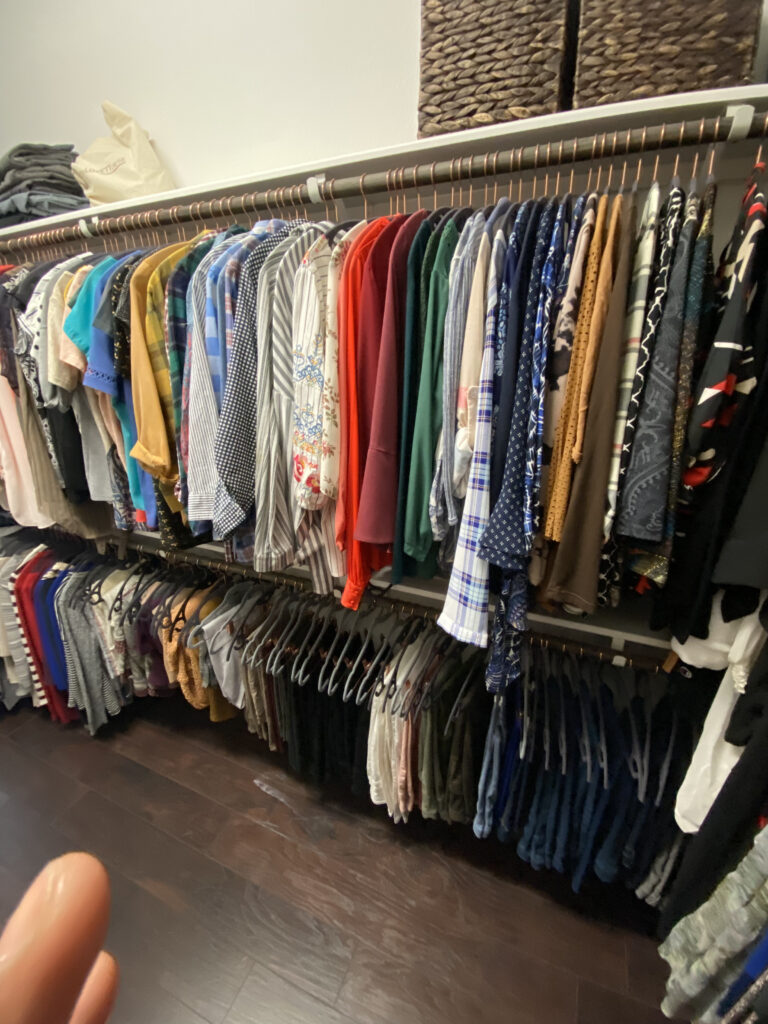
Here’s what my clients tell me after we do a real closet edit — not a spring clean, an actual edit with a framework.
They get dressed faster. Because everything in the closet fits, they like it, and they can see it all at a glance. No more standing there for fifteen minutes pulling things out and putting them back.
They stop buying duplicates. When you can see everything you own, you stop buying another black cardigan because you forgot you had three.
They feel lighter. This one surprises people, but it’s real. Letting go of clothes that represent old versions of yourself — old sizes, old jobs, old relationships — is genuinely freeing. Your closet stops being a museum and starts being a tool.
And the closet stays organized. Because when only the things you actually wear are in there, maintaining it is almost effortless. There’s room. Things have space. Nothing is crammed.
That’s the difference between a spring clean and an actual edit. One resets how it looks. The other changes how it works.
When You’re Ready
If you just did your spring closet cleanout and the maybe pile went right back in — or if you’re staring at the closet right now dreading even starting — let me help.
I’ve got a free guide: 10 Tough-Love Rules for Closet Organization. It’s the decision-making framework I use with my clients — the rules that make the maybe pile disappear. You can grab it here.
And if you want someone standing next to you while you make the hard calls — that’s literally what I do. No judgment. Just honest guidance from someone who’s done this thousands of times. In person in Houston or virtually anywhere.
Schedule your consultation here or call 832-271-7608.
Serving Houston in-home & virtual organizing sessions anywhere.
Restoring Your Sanity, Clarity & Time™

Working with Taya and her team is easy. You can book an appointment easily on her website, or contact her directly at 832-271-7608
- Pantry Organization: A Real Reset for Back-to-School Snacks - September 3, 2026
- How to Organize Shoes, Bags, and Accessories in Your Closet - September 1, 2026
- 7 Organization Tips to Streamline School Mornings - August 25, 2026